Top Options Traders: Strategies, Mindset, and Tools

Top Options Traders: Strategies, Mindset, and Tools
Top options traders are defined by their ability to match strategy selection to market conditions, manage risk with discipline, and execute plans without emotional interference. Retail standouts like Lander Schlessinger and institutional legends like Edward Thorp built their edge not on luck but on repeatable systems. The best options traders share three core traits: a clear market outlook before every trade, a preference for defined-risk strategies when conditions are uncertain, and a commitment to reviewing their own performance data. Optiqtrades brings these same principles into a free, community-driven platform where traders at every level can learn, share, and copy proven approaches.
What makes the top options traders different?
The defining quality of successful options traders is systematic execution. Retail experts emphasize treating trading as a business with a formal written plan, not a series of gut calls. Emotional, reactive trading is the single most common cause of preventable losses.

Top traders also understand that no universally the best strategy exists. The optimal approach depends on market outlook, account size, and personal risk tolerance. A trader who forces a bullish strategy into a neutral market is not disciplined; they are gambling.
The criteria that separate elite traders from average ones include:
- Strategy alignment: Every trade starts with a market outlook (bullish, bearish, neutral, or volatility-driven), then a matching strategy bucket.
- Risk profile clarity: Defined-risk strategies cap maximum loss. Undefined-risk strategies carry open-ended loss potential and require more capital and experience.
- Performance tracking: Detailed logs of entry, exit, symbol, and hold duration reveal which setups actually work.
- Technology adoption: AI tools for research and data processing are now standard among top performers.
- Emotional discipline: Consistency over time, not single big wins, defines a top trader.
Pro Tip: Before placing any trade, write down your market outlook in one sentence. If you cannot state it clearly, the trade is not ready.
## 1. Lander Schlessinger: the $1 million retail blueprint
Lander Schlessinger is one of the most documented retail options traders of 2026. He earned over $1 million trading a narrow set of highly liquid tickers including TSLA, NVDA, and SPY. His results are not a product of diversification. They come from deep specialization.
His core methods include:
- Ticker focus: He trades only high-volume names where execution speed is fast and bid-ask spreads are tight.
- 0DTE options: Zero days to expiration trades require strict discipline and specific market timing, often executed around 11 AM when volatility patterns are most readable.
- Written trading plan: Every session starts with a plan. No plan means no trade.
- Trade logging: He tracks every entry, exit, and outcome to identify which setups repeat profitably.
Schlessinger’s approach proves that retail traders do not need hundreds of tickers. They need mastery of a few. His story is the clearest modern example of how focus beats breadth in options trading.
## 2. Edward Thorp: the mathematician who changed options trading
Edward Thorp is widely credited as one of the first traders to apply quantitative methods to options pricing before the Black-Scholes model became standard. His work in the 1960s and 1970s demonstrated that options could be priced and hedged systematically, not intuitively. That insight became the foundation of modern options theory.
Thorp’s principles remain relevant today:
- Probability over prediction: He focused on expected value across many trades, not on being right on any single one.
- Position sizing: He applied the Kelly Criterion to size positions relative to edge, protecting capital during losing streaks.
- Systematic hedging: He used options to hedge equity exposure, treating them as tools for risk control rather than pure speculation.
Thorp’s legacy is the idea that options trading is a math problem, not a personality contest. Traders who internalize this shift their focus from “what will happen” to “what is the probability-weighted outcome.”
## 3. The income strategy specialists
A large category of successful options traders builds consistent returns through income strategies rather than directional bets. These traders sell premium using approaches like covered calls, cash-secured puts, iron condors, and credit spreads. Their edge is time decay, not price prediction.
Key characteristics of income-focused traders:
- High-probability setups: They sell options with a high probability of expiring worthless, typically above 70% probability of profit.
- Defined-risk structures: Iron condors and vertical spreads cap maximum loss, making position sizing straightforward.
- Volatility awareness: They sell premium when implied volatility is elevated and reduce size when it is compressed.
- Mechanical rules: Entry and exit rules are fixed before the trade opens, removing emotion from management decisions.
Income strategies are among the best options trading strategies for traders who want consistent, repeatable results without needing to predict market direction. They reward patience and process over excitement.
## 4. How successful traders select strategies effectively
Experienced traders prioritize selecting a strategy bucket based on market outlook before choosing specific mechanics. This prevents impulsive trades driven by a hot ticker or a trending idea.
The decision process follows a clear sequence:
- Define outlook: Bullish, bearish, neutral, or expecting a volatility event.
- Select strategy bucket: Directional, income, hedging, or volatility play.
- Match risk profile: Defined-risk for capital protection, undefined-risk only when experience and account size support it.
- Set rules: Entry trigger, maximum loss, profit target, and exit condition written before the trade opens.
| Strategy type | Market outlook | Risk profile |
|---|---|---|
| Long call | Bullish | Defined (premium paid) |
| Cash-secured put | Neutral to bullish | Defined (stock ownership risk) |
| Iron condor | Neutral | Defined (spread width) |
| Long straddle | High volatility expected | Defined (premium paid) |
| Naked put | Bullish | Undefined (open-ended) |
Beginners benefit most from defined-risk strategies. They cap loss at the premium paid or the spread width, which makes learning from mistakes survivable.
Pro Tip: Map every strategy you consider to a specific market outlook before you look at the options chain. If the outlook is unclear, wait.
## 5. The role of emotional discipline in consistent performance
Emotional discipline typically takes 6–8 months of consistent trading to develop into a reliable habit. That timeline surprises most beginners, who expect technical knowledge to be the hard part. The psychological side is harder.
The most common emotional traps include revenge trading after a loss, holding losing positions too long hoping for a recovery, and sizing up after a winning streak. Each of these behaviors breaks the written plan. The plan exists precisely to override these impulses.
Traders who transition from emotional to systematic execution report that the shift feels uncomfortable at first. Following rules when a trade “feels wrong” is the exact moment discipline pays off. The traders who make it past the first year are almost always the ones who built systems before they needed them.
## 6. Trade logging as a competitive advantage
Detailed trade logs track entry price, exit price, symbol, strategy type, and hold duration. Reviewing this data weekly reveals which setups generate profit and which drain capital. Most traders skip this step and then wonder why their results are inconsistent.
A useful trade log captures at minimum: the ticker, the strategy, the market outlook at entry, the planned exit, the actual exit, and a one-sentence note on what happened. Over 50 trades, patterns emerge. Over 200 trades, those patterns become a personal edge.
Win rates and P&L by symbol and holding period reveal subtle but impactful performance differences. A trader might discover they win 70% of trades on NVDA but only 40% on a less liquid name. That data alone justifies narrowing focus. Optiqtrades supports this process with real-time trade tracking and AI evaluation on every position.
## 7. How AI tools give top traders an edge
Top options traders use AI tools like Claude, Codex, and Gemini to process large datasets, build research databases, and improve decision-making speed. AI does not replace judgment. It removes the manual work that slows judgment down.
Practical AI applications for options traders include:
- Data aggregation: Pulling earnings dates, implied volatility history, and open interest data into a single view.
- Strategy screening: Filtering for setups that match a defined outlook and risk profile across hundreds of tickers.
- Code assistance: Building custom spreadsheets or scanners without needing a programming background.
- Trade review: Using chatbots like Claude or ChatGPT to analyze a trade log and identify patterns.
AI-assisted research scales from sophisticated institutional setups down to simple chatbot queries for everyday traders. A beginner can start with a free AI chatbot to review their trade notes. An advanced trader can build a full research database. The entry point is wherever you are now. Optiqtrades integrates AI evaluation directly into the trading feed, so every trade gets assessed automatically.
Key takeaways
The most consistent options traders win by matching strategy to market outlook, controlling risk with defined-loss structures, and reviewing performance data to refine their edge over time.
| Point | Details |
|---|---|
| Strategy alignment first | Define your market outlook before selecting any strategy to avoid impulsive trades. |
| Defined-risk protects capital | Beginners should use strategies like vertical spreads that cap maximum loss at the premium or spread width. |
| Trade logs build edge | Logging every trade by symbol, strategy, and outcome reveals which setups actually work for you. |
| Emotional discipline takes time | Expect 6–8 months of consistent practice before systematic execution becomes reliable. |
| AI tools are now standard | Use Claude, Codex, or Gemini to process data and review trades faster than manual methods allow. |
What I’ve learned watching traders succeed and fail
The traders who last are not the ones with the most complex strategies. They are the ones who treat options trading as a business with repeatable processes, not a hobby driven by excitement.
The biggest mistake I see is traders chasing strategies before they have a clear market outlook. They find an iron condor setup that looks attractive and then reverse-engineer a reason to be neutral. That is backward. The outlook comes first. The strategy follows.
Emotional discipline is genuinely the hardest part. Technical knowledge is learnable in weeks. Sitting on your hands when a trade moves against you, trusting your plan, and not revenge-trading after a loss takes months to build. The traders who skip this work are the ones who blow up accounts with strong technical knowledge and weak execution.
The traders I respect most keep detailed records and review them honestly. They know their win rate by ticker. They know which strategies work in which conditions for them specifically. That self-knowledge is a real edge, and it is available to anyone willing to do the documentation work.
Technology is not optional anymore. AI tools have lowered the barrier to institutional-quality research. A trader using Claude to analyze their trade log has a real advantage over one who is not. The Optiqtrades AI Options Strategist makes this accessible without requiring any technical setup.
— OptiqTrade
Optiqtrades: built for traders who take this seriously
Optiqtrades gives options traders the tools that top performers use, without the cost or complexity.
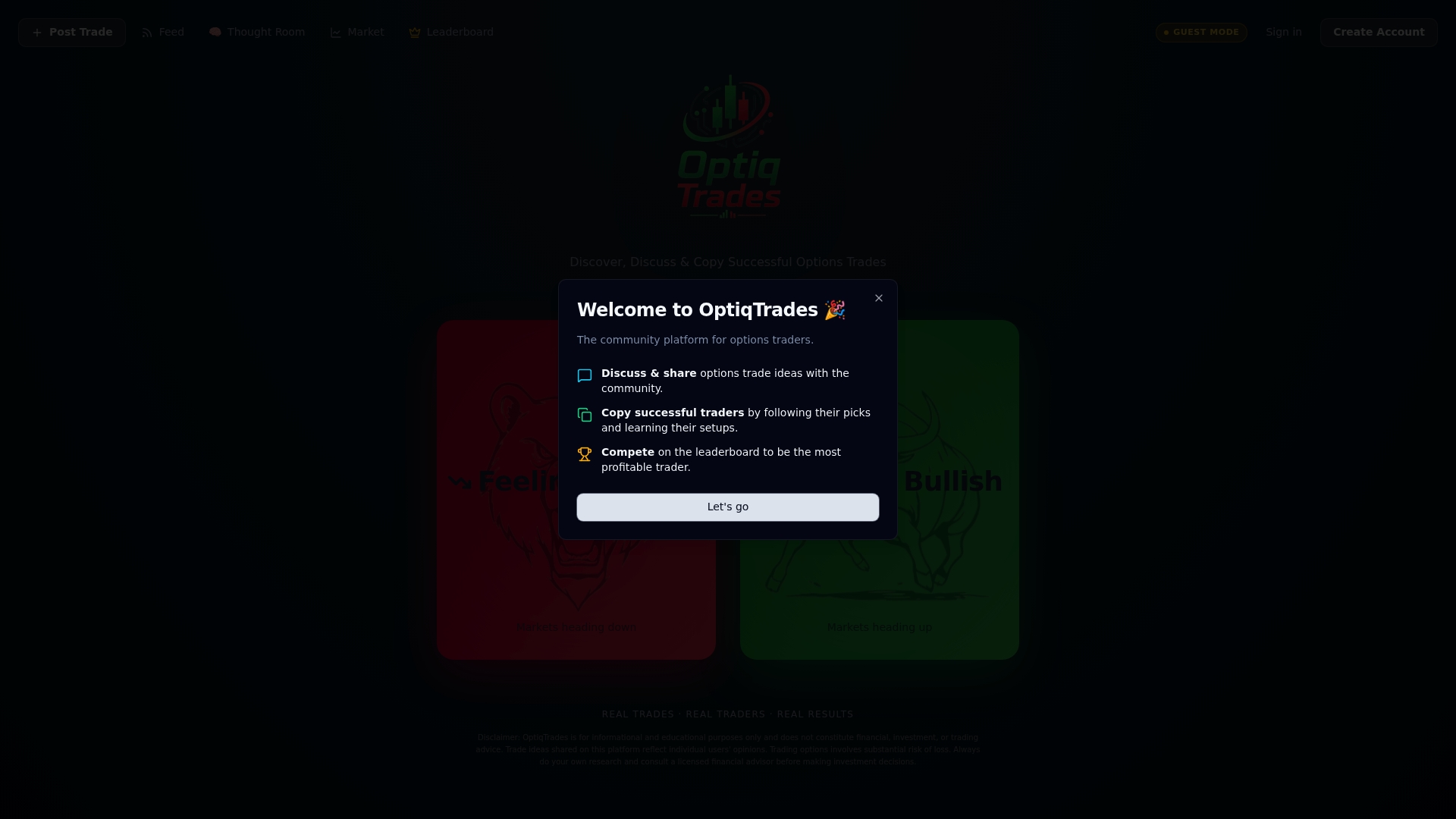
The AI Options Strategist evaluates your market outlook and recommends strategies matched to your risk profile, the same process that separates disciplined traders from reactive ones. Every trade in the feed gets AI evaluation in real time, so you see the reasoning behind each position, not just the result. The trader leaderboard shows who is performing and how, giving you real models to follow and copy directly into your own portfolio. Optiqtrades is free to join, beginner-friendly, and built around the community insight that most traders are looking for but rarely find in one place.
FAQ
Who are the top options traders to follow?
Lander Schlessinger is one of the most documented retail options traders of 2026, earning over $1 million trading TSLA, NVDA, and SPY with a disciplined, plan-driven approach. Edward Thorp is the historical benchmark for systematic, probability-based options trading.
What are the best options trading strategies for beginners?
Defined-risk strategies like long calls, long puts, and vertical spreads are best for beginners because they cap maximum loss at the premium paid or spread width. They allow new traders to learn from mistakes without catastrophic account damage.
How long does it take to become a consistently profitable options trader?
Emotional discipline, the hardest skill in trading, typically takes 6–8 months of consistent practice to develop into a reliable habit. Technical strategy knowledge can be learned faster, but execution consistency takes longer.
How do top traders use AI in options trading?
Top traders use AI tools like Claude, Codex, and Gemini to process market data, screen for strategy setups, and review trade logs for patterns. AI reduces manual research time and supports more systematic decision-making.
What is 0DTE options trading?
0DTE stands for zero days to expiration, meaning the option expires the same day it is traded. It is a high-risk, high-focus strategy used by experienced traders like Lander Schlessinger, typically executed during specific market windows with strict entry and exit rules.