Options Trading Rules: A Guide for Beginners and Intermediate Traders

Options Trading Rules: A Guide for Beginners and Intermediate Traders
"“Options trading rules” covers two distinct things: the formal U.S. regulatory and broker approval requirements you are legally obligated to follow, and the practical trading discipline that experienced traders use to stay solvent. Both matter. The SEC, FINRA, and the OCC set the framework your broker operates within. Your personal rules for position sizing, assignment handling, and event risk sit on top of that framework. Get either one wrong and the consequences are real.
Three things to do right now:
- Check your broker options approval level. Log in and confirm which tier you hold. Your approved tier determines which strategies you can legally execute in your account.
- Set a max-risk-per-trade rule before your next trade. A standard guideline is to risk no more than 1–2% of your total account on any single position.
- Bookmark the primary regulator pages (SEC, FINRA, OCC, CFTC) and note that the IRS governs how your gains are taxed. Consult a CPA for your individual tax situation.
Table of Contents
- Which U.S. agencies govern options markets?
- What do brokers require before you can trade options?
- What are the core options trading rules every trader should follow?
- What rules apply to specific strategies?
- How do you manage risk at the portfolio level?
- What are the tax rules and recordkeeping requirements for options traders?
- The hidden risk most traders miss: correlated positions
- How to put these rules into practice today
- Key Takeaways
- Why discipline beats tips every time
- How Optiqtrades helps you apply these rules in practice
- Useful sources and further reading
Which U.S. agencies govern options markets?
Four institutions shape the rules every retail options trader operates under.
The SEC (Securities and Exchange Commission) oversees securities options, including equity and ETF options. It sets the broad disclosure and market-integrity rules that exchanges and brokers must follow.
The CFTC (Commodity Futures Trading Commission) governs commodity and futures options. Under CFTC Part 32, commodity option transactions must comply with the Commodity Exchange Act unless a specific exemption applies. Most retail traders dealing in equity options won’t interact with the CFTC directly, but traders in commodity-linked products need to know it exists.
FINRA (Financial Industry Regulatory Authority) is the self-regulatory organization that enforces broker-dealer conduct, including suitability obligations and the requirement that brokers approve accounts for specific options trading levels before any options transaction can occur. FINRA also requires brokers to deliver the Characteristics and Risks of Standardized Options disclosure document to every customer before they trade.
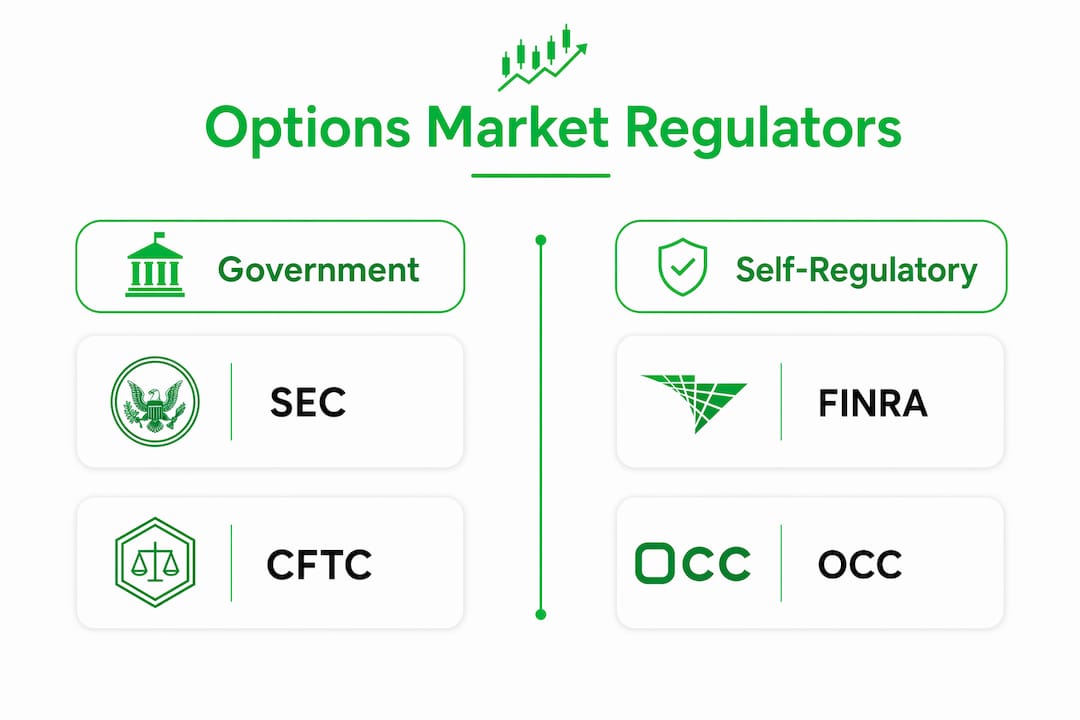
The OCC (Options Clearing Corporation) functions as the central clearinghouse for all U.S. listed options. It guarantees the performance of every standardized options contract, which is why exercise and assignment mechanics work as reliably as they do. When your short put gets assigned, the OCC is the counterparty infrastructure making that transaction settle.
Beyond these four, individual exchanges (NYSE American, Cboe, Nasdaq PHLX) each maintain their own rulebooks. NYSE American’s options rules, for example, specify exact order types, trading sessions, and price-reasonability checks that apply to every contract traded on that exchange. Your broker’s options agreement and margin documentation layer on top of all of this. The Characteristics and Risks of Standardized Options document, published by the OCC, is the single most important disclosure to read before you trade. It covers exercise mechanics, assignment risk, and position limits in plain language.
What do brokers require before you can trade options?
Brokers gate options strategies by approval tier because regulators require them to assess suitability before granting access. The evaluation looks at your account size, trading experience, income, net worth, and investment objectives. You answer these questions in an options agreement when you apply.
How approval tiers work
| Approval Level | Commonly Allowed Strategies | Typical Requirements |
|---|---|---|
| Level 1 (Basic Income) | Covered calls, cash-secured puts | Existing stock holdings or sufficient cash; minimal experience needed |
| Level 2 (Defined Risk) | Long calls and puts, debit spreads | Some trading experience; moderate account size |
| Level 3 (Spreads) | Credit spreads, iron condors, calendars | Demonstrated options experience; higher account balance |
| Level 4/5 (Uncovered Selling) | Naked calls, naked puts | Significant capital, high income, extensive experience; margin account required |

Brokers evaluate account size, experience, and financial profile before granting each tier. Most beginners start at Level 1 or 2. Uncovered selling at Level 4 or 5 requires a margin account and carries theoretically unlimited risk on the call side.
Margin basics for options traders
Margin in options trading is not just leverage. It is also the collateral your broker holds against potential losses on short positions. For a cash-secured put, you need the full purchase obligation in cash. For a naked call, margin requirements can spike dramatically during volatility events because the broker recalculates your requirement daily.
A practical rule: keep margin utilization below roughly 50% of your available margin at all times. When volatility spikes, brokers increase margin requirements. If you are already at 80% utilization, a volatility event can trigger a forced liquidation at the worst possible moment.
What to prepare for your approval application
- Account trading history (number of trades, years of experience)
- Estimated annual income and net worth
- Liquid net worth separate from real estate
- Investment objective (income, growth, speculation)
- Honest answers to the options questionnaire — brokers use this to assign your tier
Pro Tip: If your initial approval comes back lower than expected, request a review after six months of documented trading activity. Brokers can upgrade tiers when you demonstrate experience.
What are the core options trading rules every trader should follow?
These are the practical options trading rules that separate traders who survive long enough to improve from those who blow up early. Write them down. Apply them before every trade.
-
Write a trading plan before you enter any position. Capture your outlook, entry price, strike, expiration, max loss, profit target, and what you will do if assigned. A written plan removes the emotional decision-making that causes most losses.
-
Risk a small, prudent portion of your account on any single trade. If your account is $25,000, your max loss on one position is $250–$500. Size contracts accordingly: divide your max dollar risk by the max loss per contract to get your contract count.
-
Prefer defined-risk strategies until you are consistently profitable. Spreads, iron condors, and long options all cap your maximum loss at entry. Naked positions do not. Professionals treat options as income and risk-management tools, not lottery tickets. Beginners should do the same.
-
Check implied volatility (IV) rank before choosing credit vs. debit. High IV rank favors credit strategies (you sell expensive premium). Low IV rank favors debit strategies (you buy cheap premium). Entering a credit spread when IV rank is low means you collect minimal premium for the same risk.
-
Size using max-loss math, not premium collected. A $0.50 credit on a $5-wide spread has a max loss of $4.50 per share, or $450 per contract. That is the number that drives your position size, not the $50 you collected.
-
Avoid simultaneous sector concentration. Five positions in tech stocks are not five separate bets. They are one large tech bet with extra steps. Aggregate your sector exposure before adding a new position.
-
Keep margin utilization conservative. Below 50% is a reasonable target. During volatility spikes, margin requirements increase and low utilization reduces the risk of forced liquidations.
-
Set a defined exit rule before you enter. Know your profit target (often 50% of max credit for credit spreads) and your stop level. Decide in advance, not in the moment.
-
Avoid holding through earnings unless it is intentional. Earnings events cause IV crush after the announcement, which destroys the value of long options and can gap through spread strikes. If you hold through earnings, size down and know why.
-
Plan for assignment before you sell short options. Ask yourself: if I get assigned tonight, what happens? For a short put, you buy 100 shares per contract at the strike. Do you have the capital? Is that a stock you want to own?
-
Use probability and Greeks appropriately. Delta approximates the probability that an option expires in the money. Theta measures daily time decay. Vega measures sensitivity to IV changes. You do not need to memorize formulas, but you need to understand directionally what each Greek means for your position.
-
Verify liquidity before entering. Check open interest and the bid-ask spread. A wide bid-ask spread on a thinly traded option means you lose money the moment you enter. Prefer options with open interest above 500 contracts and tight spreads.
-
Execute during liquid trading windows. Liquidity is generally highest in the first hour (9:30–10:30 AM ET) and the last hour (3:00–4:00 PM ET). Multi-leg orders especially benefit from tighter spreads during these windows.
-
Review your positions weekly, not just at expiration. Markets move. A position that was safe on Monday can be at risk by Thursday. Set a calendar reminder.
-
Keep a trade journal. Log every trade with your rationale, the Greeks at entry, and what actually happened. Patterns in your losses are worth more than any tip.
Trade plan template fields to capture on every trade: underlying, direction/outlook, strategy, strike(s), expiration, IV rank at entry, max loss ($), profit target ($), assignment plan, and exit trigger.
What rules apply to specific strategies?
Covered calls
A covered call means you own 100 shares and sell a call against them. The risk is not losing money on the option. The risk is that your shares get called away at a price below where they could have traded. Watch ex-dividend dates carefully: early assignment is rare, but it is more likely when a short call is in the money and an ex-dividend date is approaching. Set a buyback threshold, typically when the call has decayed to 10–20% of the original premium, and close it rather than holding to expiration.
Debit and credit spreads
Spreads are the right starting point for most traders. A debit spread (buy one option, sell a further out-of-the-money option) costs money upfront and caps both your gain and your loss. A credit spread does the reverse: you collect premium and your max loss is the spread width minus the credit received. The tradeoff between width and premium is real: a wider spread collects more premium but also carries a larger max loss. Calculate both before you enter, and confirm the probability of profit aligns with your risk tolerance.
Iron condors
An iron condor combines a credit put spread and a credit call spread on the same underlying. You profit when the stock stays within a range. The mistake most traders make is choosing strikes too close to the current price to collect more premium, which dramatically reduces the probability of success. Watch IV rank: iron condors work best when IV is elevated and likely to contract. Avoid them on single stocks with binary events (earnings, FDA decisions) unless you are sizing very small and treating it as a speculative position.
Naked selling
Selling naked puts requires cash or margin to cover the full assignment obligation. Selling naked calls carries theoretically unlimited risk. Both require Level 4 or 5 approval. The red flags that make naked selling inappropriate: thin liquidity in the underlying, a binary event within the option’s life, and margin utilization already above 40%. Assignment on a short put means buying 100 shares at the strike price. Experienced traders using the Wheel strategy treat this as a planned outcome, not a disaster. Beginners should not start here.
How do you manage risk at the portfolio level?
Single-trade rules are necessary but not sufficient. A portfolio of individually well-sized trades can still blow up if all those trades move together.
Set three portfolio-level limits before you trade:
- Max total risk: no more than 10–15% of your account at risk across all open positions simultaneously.
- Max per-sector exposure: no more than 20–25% of your total risk in any single sector (tech, energy, financials).
- Max simultaneous positions: a number you can actively monitor. For most retail traders, 5–10 positions is manageable. More than that and monitoring quality degrades.
A simple stress test: pick your largest sector exposure and ask what happens to your portfolio if that sector drops 20% in a week. Estimate the impact on each position’s value. If the answer is “I lose more than I can absorb,” you are overconcentrated.
Pro Tip: Calculate your effective delta exposure across all open positions. Sum the deltas of every position (accounting for direction: long delta is positive, short delta is negative). A large net positive delta means you have a hidden long directional bet on the market. A large net negative delta means the reverse. This check takes five minutes and reveals concentration risk that position counts alone miss.

The most dangerous form of overconcentration is false diversification: holding many positions that all respond to the same underlying factor. Five iron condors on tech stocks, for example, are not five separate trades. They are one large bet that tech stays range-bound. The next section shows exactly how this plays out numerically.
What are the tax rules and recordkeeping requirements for options traders?
Options taxation in the U.S. depends on the type of contract and how it is used. Most equity options fall under ordinary short-term or long-term capital gains treatment. Section 1256 contracts, which include certain index options and futures options, receive a blended 60/40 tax treatment (60% long-term, 40% short-term) regardless of holding period. Whether a specific contract qualifies as a Section 1256 contract is a fact-specific determination. Confirm with a CPA.
Exercise and assignment have direct tax consequences. When a short put is assigned and you buy shares, the premium you collected reduces your cost basis in those shares. When a long call is exercised, the premium you paid increases your cost basis. These mechanics affect both your gain/loss calculation and your holding period for long-term capital gains eligibility.
Your recordkeeping checklist:
- Trade confirmations for every transaction
- Monthly brokerage statements
- 1099-B from your broker (issued by February 15 each year)
- Exercise and assignment notices
- Records of any wash-sale adjustments
Export your 1099-B at year-end and reconcile it against your own trade log. Brokers do not always capture cost basis adjustments correctly, especially after assignments. Retain all records for at least three years from the filing date, longer if your return is complex.
This article provides general information, not tax or legal advice. Consult a qualified CPA or tax professional for guidance specific to your situation.
The hidden risk most traders miss: correlated positions
Retail traders routinely mistake multiple correlated positions for genuine diversification. Five iron condors on different tech stocks are not five separate bets. They are effectively one large tech-sector bet, because when the sector moves, all five positions move together.
Here is a simple worked example. Suppose you hold five short put spreads, each with a delta of roughly -0.20 per spread (meaning each position loses value as the underlying drops). If all five underlyings are in the same sector:
- Position 1: delta -0.20
- Position 2: delta -0.18
- Position 3: delta -0.22
- Position 4: delta -0.19
- Position 5: delta -0.21
Your aggregate sector delta is approximately -1.00. That is the equivalent of being short 100 shares of a single stock in that sector. A 10-point drop in the sector hits all five positions simultaneously, and your total loss is roughly five times what any single position would show.
The pre-trade aggregation check is straightforward:
- List every open position and its current delta.
- Group positions by sector.
- Sum the deltas within each sector.
- If any sector’s aggregate delta exceeds your single-position risk limit, you are overconcentrated.
Pro Tip: Run this aggregation check daily, not just before new trades. Delta drifts as the market moves. A position that was neutral on Monday can become significantly directional by Wednesday if the underlying has moved.
How to put these rules into practice today
Follow these steps in order. Each one builds on the last.
-
Confirm your broker approval level and margin specifications. Log into your account, find your options approval tier, and read the margin requirements for the strategies you want to use. If your tier is lower than you need, start the upgrade process now.
-
Set account-level risk limits in writing. Decide your max risk per trade (1–2% of account), max total portfolio risk (10–15%), and max per-sector exposure (20–25%). Write these down somewhere you will see them before every trade.
-
Create your written trade plan template. Use the fields from Section 4: underlying, outlook, strategy, strikes, expiration, IV rank, max loss, profit target, assignment plan, exit trigger. Test it on paper before using real capital.
-
Start with paper trading. Most brokers offer paper trading accounts. Use one to practice the full workflow: plan the trade, execute it on paper, track it, and close it according to your exit rules. Paper trading and probability tools let you build confidence without real capital at risk.
-
Run pre-trade aggregation and event checks. Before adding any new position, check your sector delta exposure and verify there are no earnings, dividends, or binary events within the option’s life that you have not accounted for.
-
Start with defined-risk strategies and scale up gradually. Begin with covered calls or debit spreads. Add credit spreads once you are comfortable with the mechanics. Move to more complex structures only after you have a track record of following your rules consistently.
-
Set a weekly review calendar reminder. Every week, review open positions against your plan, recalculate sector delta exposure, and update your trade journal. Discipline in the review process is what separates traders who improve from those who repeat the same mistakes.
Key Takeaways
Options trading rules combine formal U.S. regulatory requirements (SEC, FINRA, OCC, CFTC) with a practical discipline of position sizing, defined-risk preference, and portfolio-level aggregation checks that protect your account through volatile markets.
| Point | Details |
|---|---|
| Know your regulators | SEC, FINRA, OCC, and CFTC govern U.S. options; read the OCC’s Characteristics and Risks of Standardized Options before trading. |
| Get the right broker approval | Confirm your approval tier and margin specs before placing any trade; upgrade via documented experience if needed. |
| Risk 1–2% per trade | Size every position so your max loss equals a conservative fraction of your total account. |
| Prefer defined-risk strategies first | Spreads and covered calls cap your max loss at entry; naked positions do not, and require higher approval and capital. |
| Aggregate sector exposure | Sum deltas by sector before each new trade; five correlated positions can equal one large single-sector bet. |
| Keep records and consult a CPA | Retain trade confirmations, monthly statements, 1099-B, and exercise notices; confirm your specific tax treatment with a qualified professional. |
| Use Optiqtrades to practice | Optiqtrades’s community feed, AI trade evaluation, and copy-trade features let you apply these rules in a structured, real-time environment. |
Why discipline beats tips every time
The options trading world has no shortage of people selling the next great setup. What it has a shortage of is traders who follow a written plan consistently for six months straight. The research on this is not subtle: a predefined written plan with explicit entry, exit, sizing, and assignment rules removes the emotional decision-making that causes most losses. Not some losses. Most losses.
The traders who last are not the ones who found the best strategy. They are the ones who applied an adequate strategy with iron consistency. A covered call program executed with discipline beats a sophisticated multi-leg structure executed impulsively, every time. The edge in retail options trading is almost never the strategy itself. It is the process around it.
Community matters here too. Trading in isolation means your only feedback loop is your own P&L, which is noisy and slow. Structured practice alongside other traders, with real-time feedback on your reasoning, compresses the learning curve considerably. That is not a soft benefit. It is a measurable one.
How Optiqtrades helps you apply these rules in practice
Most traders read a guide like this and then return to trading exactly as they did before, because nothing in their workflow changed. Optiqtrades is built to close that gap.
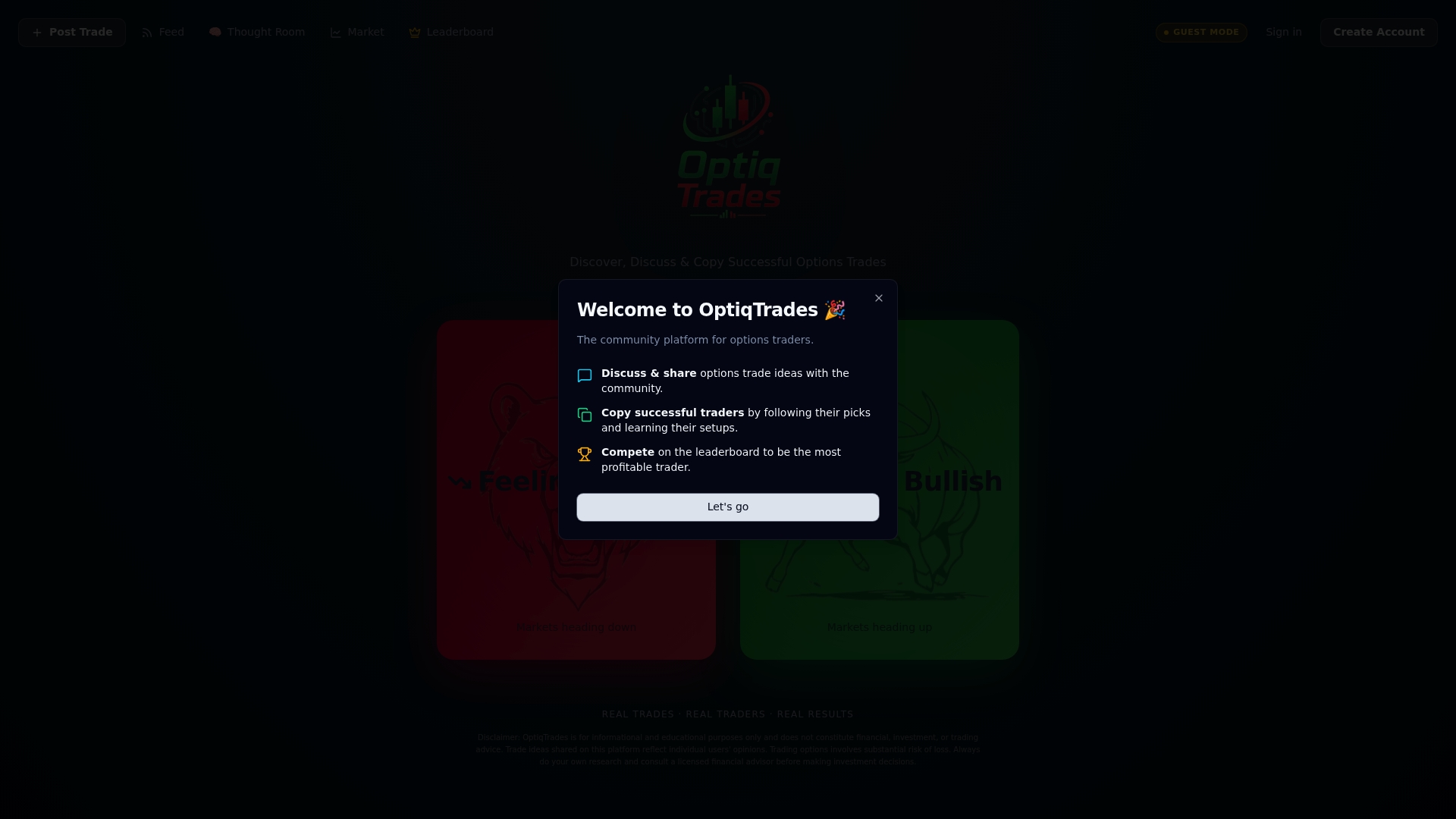
The platform’s community trade feed lets you see how other traders are structuring positions in real time, which means you are not learning in a vacuum. The AI Options Strategist evaluates every trade idea against key criteria, giving you an additional data point before you commit capital. You can follow experienced traders and observe how they apply position sizing and exit rules in practice, and the copy-trade feature lets you mirror those trades directly into your own portfolio. Integrated brokerage account tracking means your aggregated exposure is visible in one place, which directly supports the sector-delta aggregation checks this guide recommends.
Optiqtrades is free to start. Premium filters unlock advanced trader analytics, including win rate, returns, and follower stats, so you can identify traders whose discipline matches the rules in this guide. Start by browsing the trade feed and using the AI evaluator on your next planned trade before you place it.
Using any platform is a learning and execution aid, not a guarantee of profit. Market risk is always present. Review the risk disclosure before trading, and consult a tax professional for your individual circumstances.
Useful sources and further reading
Primary regulator and authoritative education pages to verify rules and read full guidance:
- FINRA — Options: Broker approval requirements, suitability obligations, and the Characteristics and Risks of Standardized Options disclosure requirement.
- SEC — Investor.gov Options Bulletin: Plain-language overview of how options work, risks, and investor protections.
- SEC — Binary Options Fraud: Identifies fraudulent options products to avoid; useful for distinguishing legitimate listed options from scams.
- Investor.gov — Ex-Dividend Dates: Explains ex-dividend mechanics relevant to early assignment risk on covered calls.
- CFTC — Part 32, Commodity Option Transactions: Full regulatory text governing commodity options; relevant if you trade commodity-linked products.
- OCC — Options Education (optionseducation.org): The OCC’s investor education site; covers exercise/assignment mechanics, strategy basics, and the standardized options disclosure document.
- OCC — Equity vs. Index Options: Explains the structural differences between equity and index options, including settlement and Section 1256 treatment relevance.
- IRS.gov: Search “options” and “Section 1256 contracts” for official tax treatment guidance; confirm your specific situation with a CPA.
- Your broker’s options agreement and margin documentation: The definitive source for your account’s specific approval tiers, margin requirements, and exercise procedures. Always read the broker-specific version, not a generic summary.
Confirm broker-specific approval and margin details directly with your broker’s documentation. Regulator pages reflect the rules as written; broker implementation details vary.