Options Copy Trading: A Beginner's Complete Guide

Options Copy Trading: A Beginner’s Complete Guide
Options copy trading is the automatic replication of trades placed by experienced options traders directly into a follower’s brokerage account. You pick a lead trader, set your risk parameters, and their positions mirror in your account in real time, including multi-leg strategies, specific strike prices, and expiration dates. No need to decode the Greeks or build your own strategy from scratch.
Here is how the core structure works:
- Lead trader: An experienced options trader whose positions are made available for others to copy
- Follower: The investor who subscribes to a lead trader’s feed and receives replicated trades
- Platform: The technology layer connecting both parties, handling execution, compliance, and risk controls
- Risk parameters: Follower-defined settings including position sizing, daily loss limits, and ticker filters that govern how trades are copied
The appeal is straightforward. Options are among the most complex instruments retail traders encounter, and copy trading lowers the barrier to entry without requiring years of study.
Table of Contents
- How options copy trading actually works
- Why copy trading options can work in your favor
- The real risks you need to understand
- Alternative approaches worth knowing
- How AI and community platforms are changing the game
- What to keep in mind before you start
- Optiqtrades gives you the edge that solo trading does not
- Key Takeaways
How options copy trading actually works
The process starts with trader selection. Followers browse a platform’s leaderboard or trader directory, filtering by metrics like win rate, average return, and maximum drawdown. Once you follow a lead trader, the platform monitors their brokerage account and replicates each new position into yours, usually within seconds of execution.
Cross-brokerage platforms have made this significantly more accessible. Rather than forcing everyone onto a single broker, modern copy trading infrastructure connects accounts across different brokerages, so you keep your existing account while still receiving copied trades. Some platforms support execution in under one second after the lead trader opens a position.
Follower controls are where the real customization lives:
- Position sizing: Set a fixed dollar amount or a percentage of your portfolio per copied trade
- Daily loss limits: Automatically pause copying if losses hit a defined threshold
- Ticker filters: Restrict copying to specific underlyings or exclude sectors you want to avoid
- Approval mode: Require manual confirmation before each trade executes, giving you a final check
The technology behind this relies on brokerage API integrations that read the lead trader’s account in real time and translate their exact position, including contract type, strike, and expiration, into an equivalent order for the follower’s account. Sizing is adjusted proportionally based on the follower’s settings.
Pro Tip: Before enabling fully automated execution, run the platform in approval mode for two to four weeks. You will learn how the lead trader thinks and catch any positions that fall outside your risk comfort zone before they hit your account.

Why copy trading options can work in your favor
The most obvious benefit is access. Complex options strategies like iron condors, calendar spreads, and ratio spreads require years of practice to execute confidently. Copy trading puts those strategies to work in your account while you are still learning what they mean.
Beyond access, here is what else you gain:
- Real-time education: Watching a skilled trader’s positions appear in your account, with entry timing, strike selection, and expiration choice visible, teaches you more than most courses
- Diversification: You can follow multiple lead traders with different styles, spreading exposure across directional plays, income strategies, and volatility trades simultaneously
- Time savings: You skip the daily research, earnings calendar scanning, and technical analysis that active options trading demands
- Brokerage continuity: Most modern platforms let you keep your existing broker, so your existing tools, tax records, and account history stay intact
- Customizable risk: Position sizing and loss limits mean you are never fully at the mercy of another trader’s conviction level
For options trading for beginners, the combination of real exposure and real-time observation is hard to replicate through paper trading alone. You are learning with actual stakes, but with guardrails in place.
The real risks you need to understand
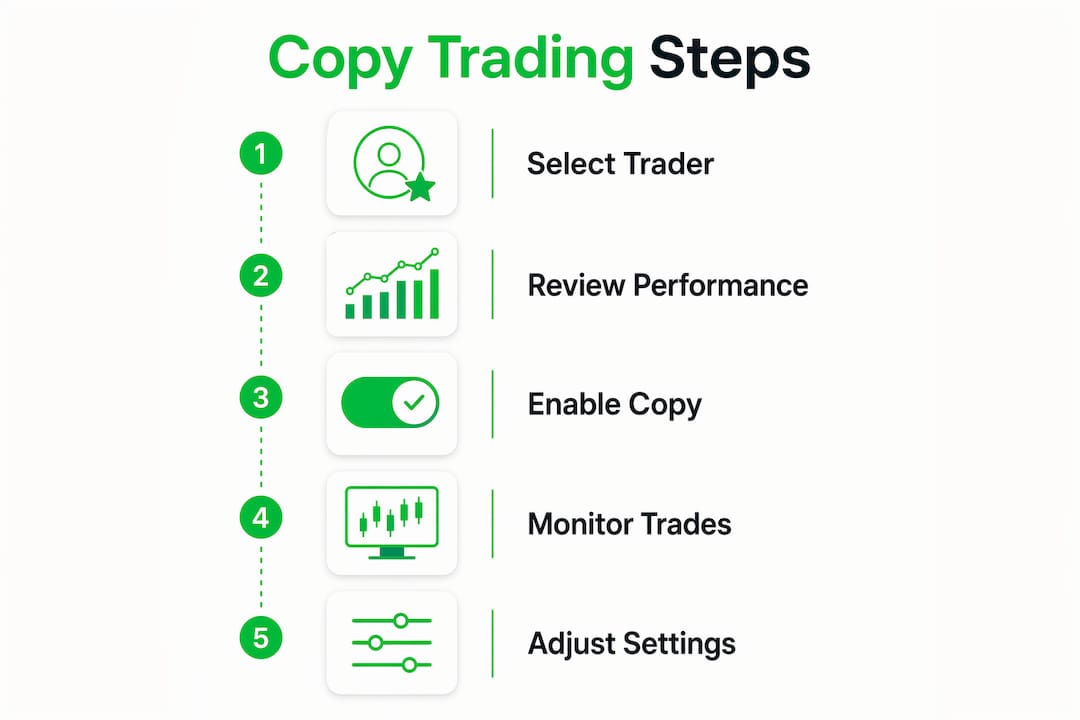
Copy trading does not eliminate risk. It redistributes who makes the decisions, and that shift carries its own set of problems.
Options carry inherent leverage and complexity that can produce large losses quickly, even when the lead trader has a strong track record. A single earnings trade gone wrong can wipe out weeks of gains. Past performance in options is particularly unreliable as a forward indicator because market regimes change and strategies that worked in low-volatility environments collapse when the VIX spikes.
The key risks to keep in mind:
- Lead trader dependency: If their strategy stops working, your account suffers before you have time to react
- Automation errors: Execution delays, API outages, or sizing miscalculations can result in positions that do not match what you intended
- Over-reliance: Copying trades without understanding them stunts your development as a trader and leaves you unable to manage positions if the platform goes down
- Subscription and performance fees: Platform costs can erode returns, especially on smaller accounts where fees represent a larger share of gains
- Regulatory exposure: You remain responsible for your own account’s compliance with U.S. securities laws, regardless of who generated the trade idea
- Slippage: Options markets are less liquid than equities, so a follower’s fill price may differ meaningfully from the lead trader’s, particularly on multi-leg strategies
Pro Tip: Review your copied positions at least once daily. Set a personal stop-loss rule, separate from the platform’s automation, so you can manually exit a position if the lead trader holds through a loss you are not comfortable with.
Alternative approaches worth knowing
Copy trading is not the only way to access other traders’ strategies. Several related methods offer different tradeoffs between automation, control, and cost.
Mirror trading is the closest relative. Instead of copying individual trades from a specific person, mirror trading replicates an entire algorithmic trading system. You subscribe to a strategy, and every signal that system generates executes in your account automatically. The distinction matters: copy trading follows a human, mirror trading follows a rule set. Mirror trading may involve different risk profiles and less follower discretion, since you are trusting a coded system rather than a person you can evaluate by their track record.
Here is a quick comparison of the main alternatives:
- Signal following (semi-manual): A lead trader publishes alerts via text, email, or a chat group, and you execute the trades yourself. More control, more effort, and execution timing is entirely on you
- Options-focused ETFs: Funds like covered-call ETFs give you systematic options exposure without any copying or execution on your part. Less upside, but also less complexity and no platform dependency
- Managed accounts: A registered investment advisor trades options on your behalf under a formal agreement. Highest oversight, highest cost, and requires meeting minimum account thresholds
- Social trading communities: Platforms where traders share ideas and discuss strategies without full automation. You decide what to act on, blending community insight with personal judgment
Each approach sits on a spectrum from fully automated to fully discretionary. Automated copy trading sits near the automated end but still gives followers meaningful control through their risk settings, which is what separates it from a pure black-box system.
How AI and community platforms are changing the game
The shift from manual alert sharing to fully automated, cross-brokerage options copying represents a genuine change in how retail traders access sophisticated strategies. What makes the current generation of platforms different is the layer of AI analysis sitting on top of the copy trading infrastructure.

Social trading platforms now integrate AI to analyze trade risks and performance, helping followers make more informed decisions rather than copying blindly. That means getting a risk score on a trade before it executes, not just seeing the position appear in your account.
Optiqtrades is built around exactly this model. The platform combines:
- Real-time trade idea sharing: Traders post their setups, reasoning, and entries as they happen, not after the fact
- AI-powered trade evaluations: Every trade shared on the platform receives an automated risk and quality assessment, giving followers a second opinion before they copy
- Performance leaderboards: Filter traders by win rate, total return, and follower count to identify who is actually worth copying
- Brokerage integration: Keep your existing account and connect it to Optiqtrades to copy trades directly, without switching brokers
- Community forums: Discuss strategies, ask questions, and learn from peers in a space built specifically for options traders
The community dimension matters more than it sounds. Options trading is isolating by default. Most retail traders make decisions alone, without access to the reasoning behind a trade or the ability to pressure-test an idea. A platform where traders explain their setups and respond to questions changes that dynamic entirely.
Optiqtrades is free to join, with a premium subscription unlocking advanced filters and deeper analytics for traders who want to go further than the free tier allows.
What to keep in mind before you start
Options copy trading works best when you treat it as a tool, not a shortcut. Here is the honest summary:
- It is genuinely accessible: You do not need to master multi-leg strategies or options pricing theory to get started, but you do need to understand what you are copying well enough to manage it
- Trader selection is everything: Spend more time evaluating lead traders than any other part of the process. Look at drawdown history, not just returns. A 60% win rate with a 3:1 loss-to-win ratio is worse than a 45% win rate with a 2:1 ratio
- Risk settings are not optional: Position sizing and daily loss limits are the only real protection you have when a lead trader makes a bad call
- AI evaluation adds a meaningful layer: Platforms that score trades before execution give you information that pure copy trading does not
- Start small: Run copied trades at reduced size for the first month. Confirm that execution works as expected, that fills are reasonable, and that the lead trader’s style matches your actual risk tolerance, not just your stated one
- Stay compliant: Your account, your responsibility. Review the risk disclosure for any platform you use and understand how brokerage connectivity is handled
Optiqtrades brings together the trader community, AI evaluation, and brokerage integration in one place, making it one of the more complete environments for anyone approaching options copy trading seriously.
Optiqtrades gives you the edge that solo trading does not
Most copy trading platforms hand you a list of traders and a copy button. Optiqtrades does something different: it puts you inside a community where the reasoning behind every trade is visible, AI-scored, and open for discussion before you decide to copy it.
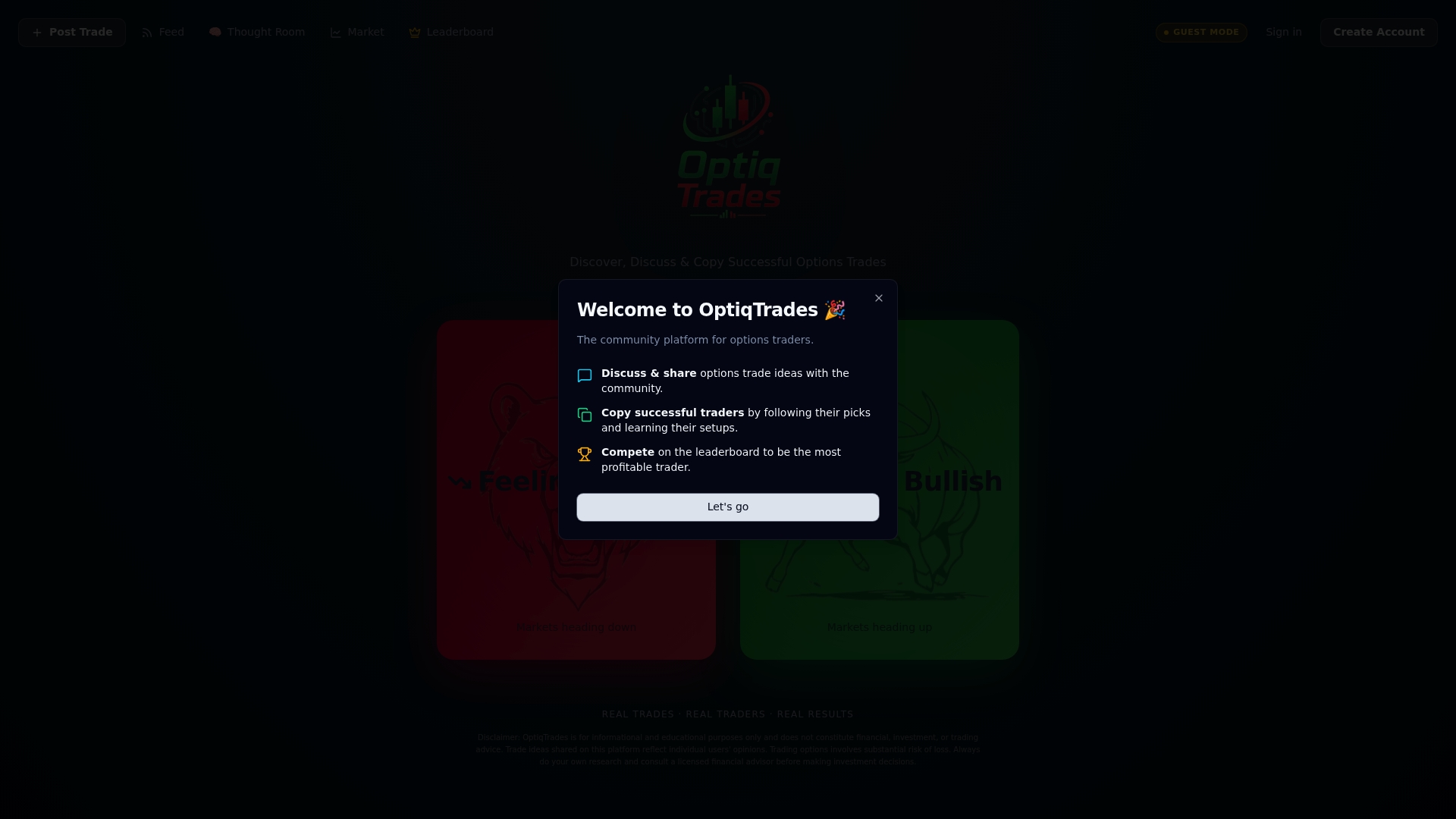
You keep your existing brokerage account. You follow traders whose performance you can verify through real leaderboard data. Every trade idea on the platform gets an AI evaluation, so you are never copying blind. The AI Options Strategist gives you a risk breakdown on any position, whether you copied it or built it yourself. And the whole platform is free to start, with no commitment required to access the community and live trade feed.
If you are serious about options copy trading and want more than automation alone, Optiqtrades is where to start. Join free at optiqtrades.com.
Key Takeaways
Options copy trading gives retail traders access to expert-level strategies through automation, but trader selection, risk settings, and platform quality determine whether it actually works in your favor.
| Point | Details |
|---|---|
| How it works | Trades from a lead trader replicate automatically into your account, including strike, expiration, and contract type. |
| Biggest risk | Options leverage can produce large losses fast, even when following a skilled trader with a strong track record. |
| Trader selection | Evaluate drawdown history and risk-adjusted returns, not just win rate or total return figures. |
| AI evaluation advantage | Platforms that score trades before execution give followers a risk layer that standard copy trading lacks. |
| Optiqtrades | Combines AI trade evaluations, community forums, performance leaderboards, and brokerage integration in one free platform. |