Options Trading for Beginners: Your Step-by-Step Guide

Options Trading for Beginners: Your Step-by-Step Guide
What is options trading and how can beginners start right away?
Options trading gives you the right, but not the obligation, to buy or sell a stock at a specific price before a set date. You pay a premium for that right, and if the trade doesn’t go your way, the most you lose as a buyer is that premium. That’s the core appeal for new traders: defined risk on the buying side, with real upside if you read the market correctly.
Every options contract is standardized by the OCC and covers 100 shares of the underlying stock. So when you see a $2 premium on a contract, your actual cost is $200, not $2. That multiplier catches beginners off guard more than almost anything else.
The four foundational moves in options are:
- Buy a call — you expect the stock to rise; you lock in the right to buy at today’s price.
- Buy a put — you expect the stock to fall; you lock in the right to sell at today’s price.
- Sell a call — you collect a premium and take on the obligation to sell shares if the buyer exercises.
- Sell a put — you collect a premium and take on the obligation to buy shares if the buyer exercises.
Three terms you need before placing a single trade: the strike price (the price at which you can buy or sell), the expiration date (the deadline for exercising the contract), and the premium (what you pay or collect for the contract). An option is in the money when exercising it would be profitable, and out of the money when it wouldn’t. Most beginner trades involve buying calls or puts, where your maximum loss is capped at the premium paid.
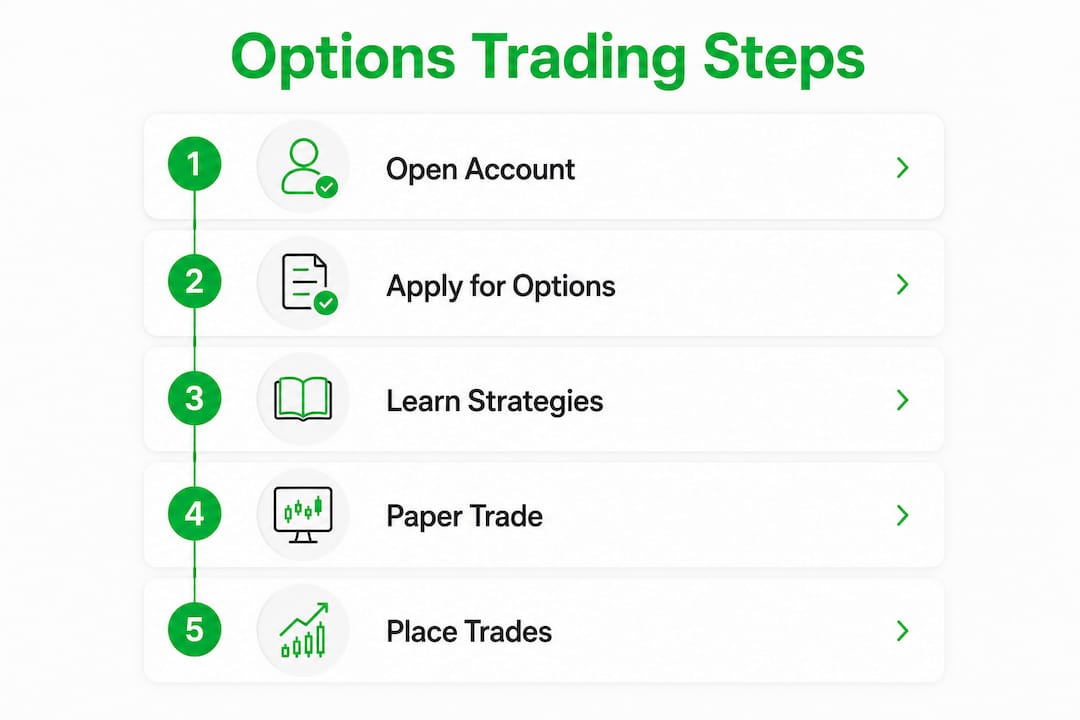
To start, you need a brokerage account that supports options trading. Most major U.S. brokerages offer this, and the application takes about 15 minutes. From there, the path is straightforward:
- Open and fund a brokerage account.
- Apply for options trading approval (Level 1 or Level 2 for beginners).
- Study the options chain for a stock you already follow.
- Start with a single long call or long put on a stock you understand.
- Keep position sizes small while you’re learning.
How to open an options trading account and place your first trades
Opening an options account is a two-step process: first you open a standard brokerage account, then you apply specifically for options trading approval. Brokerages ask about your income, net worth, trading experience, and investment objectives. Be honest. The approval level you receive determines which strategies you can use.

Options approval levels typically run from Level 1 through Level 4 or 5, depending on the broker. Level 1 lets you sell covered calls against shares you already own. Level 2 opens up buying calls and puts outright. Most beginners start at Level 1 or 2, which is exactly where you want to be. Higher levels unlock strategies with unlimited loss potential, and those aren’t for anyone just getting started.
Reading an options chain is the next skill to develop. An options chain lists every available contract for a given stock, organized by expiration date and strike price. The left side shows calls; the right side shows puts. Key columns to focus on:
- Strike price — the price at which you’d buy or sell the underlying shares.
- Bid/Ask — the range of what buyers will pay and sellers will accept; your fill price lands somewhere in between.
- Volume — how many contracts traded today; higher volume means easier entry and exit.
- Open interest — total outstanding contracts; a sign of how liquid the market is for that strike.
- Implied volatility (IV) — a measure of how much price movement the market expects; higher IV means pricier options.
To place your first trade, navigate to the options chain for a stock you follow, select an expiration date two to four weeks out, and choose a strike price near the current stock price. Click “Buy to Open” for a long call or put, enter the number of contracts (start with one), and set a limit order at or near the ask price. Review the order carefully before submitting.
- Choose a stock you already understand and track.
- Select an expiration at least two weeks out to give the trade time to work.
- Buy one contract to start; resist the urge to go bigger.
- Use a limit order, not a market order, to control your fill price.
- Set a mental stop: if the option loses half its value, exit.
Pro Tip: Before risking real money, spend two weeks placing trades in a paper trading account. Most brokerages offer simulated trading environments where you can practice reading chains, entering orders, and managing positions without any capital at risk. Paper trading builds the muscle memory that makes real trades feel less stressful.
Five beginner-friendly options strategies explained
New traders don’t need a dozen strategies. They need five that work, that they understand deeply, and that fit different market conditions. Here they are.
Long call
You buy a call when you expect a stock to rise before expiration. Say a stock trades at $50 and you buy a call with a $52 strike for a $1.50 premium. Your total cost is $150 per contract. If the stock climbs to $57 before expiration, your option is worth at least $5, and you’ve more than tripled your money. If the stock stays flat or drops, you lose the $150 premium. That’s your maximum loss.
Long calls are the most common starting point because the risk is capped and the concept is intuitive: you’re betting the stock goes up.
Long put
A long put works the same way in reverse. You buy a put when you expect a stock to fall. If a stock trades at $80 and you buy a put with a $78 strike for $2, your breakeven is $76. Below that, you profit dollar for dollar. Above $78 at expiration, the put expires worthless and you lose the $200 premium.
Long puts are also useful as portfolio protection. If you own shares of a stock and worry about a short-term drop, buying a put acts like insurance.
Covered call
A covered call means you own 100 shares of a stock and sell a call option against them. You collect the premium immediately. If the stock stays below the strike price at expiration, the option expires worthless and you keep the premium as income. If the stock rises above the strike, your shares get called away at that price, but you still keep the premium.
This is one of the most popular income-generating strategies among traders who already hold stock positions. It works best in flat or mildly bullish markets.
Pro Tip: When selling covered calls, choose a strike price above your cost basis so that even if your shares get called away, you still profit on the stock position itself. Combining that gain with the premium collected often beats simply holding the stock.
Cash-secured put (short put)
Selling a put while holding enough cash to buy the shares if assigned is called a cash-secured put. You collect a premium upfront. If the stock stays above your strike price, the put expires worthless and you keep the cash. If the stock drops below your strike, you’re obligated to buy 100 shares at that price, but you’ve already decided you’d be happy owning the stock at that level.
This strategy works well when you want to buy a stock at a discount. Instead of placing a limit buy order and hoping, you get paid to wait.
Married put
A married put means you buy shares of a stock and simultaneously buy a put option on those same shares. The put acts as a floor. If the stock drops sharply, your put gains value and offsets the loss. If the stock rises, you profit on the shares and the put expires worthless, costing you only the premium.
Think of it as buying insurance on a stock you believe in long-term but want to protect in the short term.
- Long call — bullish bet with capped downside; maximum loss is the premium paid.
- Long put — bearish bet or portfolio hedge; maximum loss is the premium paid.
- Covered call — income generation on shares you already own; works in flat markets.
- Cash-secured put — get paid to wait for a stock to reach your target buy price.
- Married put — protect a long stock position against a sharp drop.
What tools and calculators help beginners analyze options trades?
The right tools don’t just make options trading easier. They change what you’re able to see. Without them, you’re guessing at risk and reward. With them, you can model a trade before you place it and know exactly what has to happen for you to profit.
Profit/loss and breakeven calculators
Every options trade has a breakeven point: the price the underlying stock must reach for you to neither gain nor lose. For a long call, breakeven equals the strike price plus the premium paid. For a long put, it’s the strike price minus the premium. A profit/loss calculator lets you input your strike, premium, and expiration, then shows you a payoff diagram across a range of stock prices. Most brokerages build these directly into their platforms.

Greeks calculators
Understanding the Greeks is what separates traders who consistently manage risk from those who get blind sided. The four you need to know:
- Delta measures how much the option’s price moves for every $1 move in the underlying stock. A delta of 0.50 means the option gains $0.50 for every $1 the stock rises.
- Theta measures time decay: how much value the option loses each day as expiration approaches. Buyers lose to theta; sellers benefit from it.
- Gamma measures how fast delta itself changes as the stock moves. High gamma means your delta can shift quickly, which amplifies both gains and losses.
- Vega measures sensitivity to implied volatility. A high-vega option gains value when volatility spikes and loses value when it collapses.
Neglecting the Greeks leads to unexpected losses even when your market direction is correct. A stock can move exactly where you predicted, and your option can still lose money if implied volatility drops sharply after you buy. This phenomenon, called IV crush, hits hardest around earnings announcements.
Paper trading platforms
Simulated trading environments let you practice placing real orders, reading chains, and managing Greeks without putting capital at risk. They’re the single best tool for building confidence before going live.
Backtesting and strategy visualization tools
Backtesting lets you run a strategy against historical price data to see how it would have performed. Strategy visualizers show you the payoff curve of a trade at different stock prices and time points. Together, they help you understand not just whether a strategy can work, but under what conditions it tends to succeed.
- Profit/loss calculator — models your trade’s outcome across a range of stock prices.
- Breakeven calculator — tells you exactly what the stock must do for you to profit.
- Greeks calculator — shows delta, theta, gamma, and vega for any contract.
- Paper trading platform — practice without real money on the line.
- Backtesting tool — tests your strategy against historical data before you commit capital.
Optiqtrades integrates AI evaluation on every trade idea shared on the platform, giving beginners real-time feedback on risk and reward before they act. The AI Options Strategist tool is built specifically for traders who want to model trades and get structured analysis without needing years of experience first.
Risks and complex options trades beginners should avoid initially
Options carry risks that stocks don’t, and some of those risks are severe enough to wipe out an account in a single trade. Knowing what to avoid early on is just as important as knowing what to do.
The most basic risk for buyers is losing the entire premium. If you pay $300 for a call and the stock never reaches your strike price, that $300 is gone at expiration. That’s painful but manageable. The risks on the selling side are a different story.
Naked calls are the most dangerous trade a beginner can stumble into. Selling a call without owning the underlying shares means your loss is theoretically unlimited: if the stock skyrockets, you’re obligated to deliver shares at the strike price no matter how high the market price goes. Most brokerages block this at lower approval levels, and for good reason.
Uncovered puts carry similar danger. Selling a put without the cash to buy the shares means you could be forced to purchase a stock that’s in freefall, with losses limited only by how far the stock can drop (which, in theory, is to zero).
Zero-day options (0DTE) have become popular on social media, but they’re not for beginners. These contracts expire the same day they’re traded, which means theta decay is extreme and price moves are violent. A small move against you can eliminate the entire position in minutes.
Multi-leg spreads like iron condors, butterflies, and strangles involve multiple contracts with interdependent risk profiles. They can be powerful tools, but they require a solid understanding of how each leg interacts. Jumping into spreads before you’ve mastered single-leg trades is a fast way to make expensive mistakes.
Pro Tip: Set a rule for yourself before you place any trade: define the maximum dollar amount you’re willing to lose on that position. If the option hits that loss threshold, exit without hesitation. The traders who survive long enough to get good at this are the ones who protect their capital early.
Risks to avoid as a beginner:
- Selling naked calls or uncovered puts without the capital or shares to back them.
- Trading zero-day options before you understand how theta decay accelerates near expiration.
- Entering multi-leg strategies before you’ve placed and managed at least 20 single-leg trades.
- Ignoring implied volatility when buying options, especially around earnings.
- Sizing positions too large relative to your account; one bad trade shouldn’t threaten your ability to keep trading.
Options approval tiers exist precisely to protect beginners from these situations. Level 1 and Level 2 accounts are restricted to strategies where your maximum loss is defined upfront. Stay there until you’ve built real experience.
How to build confidence and find community support as a new options trader
Confidence in options trading doesn’t come from reading more articles. It comes from placing trades, managing them, and learning from what happens, preferably in an environment where you’re not doing it alone.
The first step is writing a trading plan before you place your first real trade. A trading plan doesn’t need to be long. It needs to answer three questions: What market conditions will I trade in? What strategies will I use? How much am I willing to lose per trade and per week? Traders who formalize their plans before trading are far better equipped to stick to their rules when a position moves against them.
Paper trading is the second pillar. Spend at least two weeks placing simulated trades before going live. Track your results, review your decisions, and pay attention to how the Greeks affected your positions. The goal isn’t to make fake money. It’s to build the decision-making habits that carry over to real trades.
The psychological side of trading is where most beginners struggle most. Managing losses without letting them spiral into revenge trading is a skill that takes time to develop. Accepting that a losing trade doesn’t mean you made a bad decision, just that the market moved differently than you expected, is a mindset shift that separates traders who improve from those who quit.
Community support accelerates all of this. When you can see how experienced traders are thinking about a position, what strikes they’re choosing and why, and how they’re managing risk in real time, you learn faster than any textbook allows.
Optiqtrades is built around exactly that model. The platform lets you follow experienced traders, see their trade ideas with AI-powered evaluations attached, and copy those trades directly into your own portfolio. For beginners, that means you’re not just reading about strategy in the abstract. You’re watching real decisions get made and explained, in real time.
Confidence-building practices that work:
- Write a one-page trading plan covering your market outlook, preferred strategies, and maximum loss limits before your first live trade.
- Complete at least two weeks of paper trading and review every position you opened and closed.
- Join a community of active options traders where you can ask questions and see how others approach the same market conditions.
- Follow traders whose win rates and return profiles you can verify, not just social media personalities with no track record.
- Accept small losses as tuition. Every losing trade teaches you something a winning trade can’t.
The live market data on Optiqtrades gives beginners a real-time view of trending stocks and options activity, which helps you spot opportunities without having to build a full research process from scratch. The platform is free to join, which means there’s no financial barrier to getting started with community-based learning.
Key Takeaways
Options trading for beginners is most successful when you start with defined-risk strategies, understand the Greeks before sizing up, and practice consistently in a community where experienced traders share their reasoning in real time.
| Point | Details |
|---|---|
| Contracts cover 100 shares | A $2 premium costs $200 per contract; always account for the multiplier before entering a trade. |
| Start at approval Level 1 or 2 | These levels restrict you to defined-risk trades, protecting your capital while you build experience. |
| Learn the four core Greeks | Delta, Theta, Gamma, and Vega explain why options gain or lose value beyond just stock direction. |
| Paper trade before going live | Simulated trading builds order-entry habits and exposes you to how Greeks affect real positions. |
| Community accelerates learning | Following and copying experienced traders on Optiqtrades gives beginners real-time strategy context. |