Options Exit Strategy: Your 2026 Practical Guide

Options Exit Strategy: Your 2026 Practical Guide
What is an options exit strategy, and why does it matter?
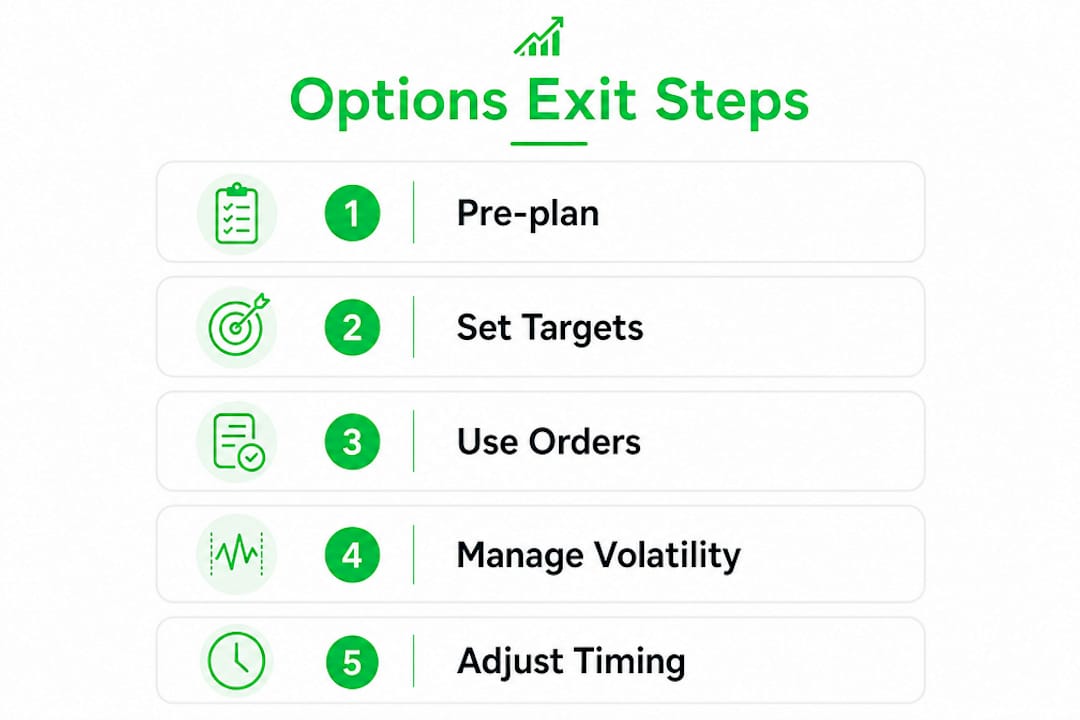
An options exit strategy is a pre-planned set of rules that defines exactly when and how you close a position, whether to lock in profit or cut a loss before it grows. You decide these rules before the trade opens, not while you’re watching the position move against you. The four core tools that make this work are stop orders, limit orders, trailing stop orders, and one-cancels-other (OCO) orders. Together, they let you automate discipline and remove emotion from the equation.
- Stop orders trigger a market close when a loss threshold is hit, acting as a hard floor on downside.
- Limit orders close the position at a specific price you set in advance, locking in a profit target.
- Trailing stop orders follow the position’s price upward and freeze when price reverses, protecting gains dynamically.
- OCO orders combine a profit target and a stop loss into one automated mechanism: when one side triggers, the other cancels.
Pre-planning exits is what separates traders who survive long stretches from those who give back gains on one bad hold. Without written rules, you’re making decisions under pressure with no framework.

Planning your exit before you place the trade
The best time to define your exit is before you click “buy.” Once a position is live and moving, cognitive bias takes over. You hold losers hoping for a bounce, and you exit winners too early out of fear.
- Profit targets should match the strategy. For short options, capturing 50% of max profit is the most widely used rule because it balances reward against the risk of a reversal. Covered calls can justify holding to a significant portion of premium collected.
- Stop loss thresholds for short premium positions are most effective when set at 2x to 3x the initial credit received. A 2x stop fires more often but caps per-trade damage; 3x gives more room to recover at the cost of a larger loss when it does trigger.
- The 21 DTE rule is a time-based exit: close short options positions when 21 or fewer days remain before expiration. Inside that window, gamma risk accelerates sharply, and a modest move in the underlying can cause a fast, outsized swing in position value.
- Write it down. Your exit plan should be specific enough that someone else could execute it by reading it. “I’ll exit when it feels right” is not a rule.
Pro Tip: Pair the 50% profit rule with the 21 DTE rule: whichever trigger arrives first is your exit signal. For positions opened at 21–30 DTE, the time clock often becomes the binding constraint.
How to use stop, limit, trailing stop, and OCO orders
Knowing which order type to use, and when, is where the plan becomes executable.

Stop orders act as your loss floor. You set a price level, and if the position reaches it, a market order fires to close. The risk is slippage: in a fast-moving market, the fill may be worse than the stop price. Use them for defined-risk positions where you need a hard cutoff.
Limit orders are cleaner for profit-taking. You set the exact price at which you want to close, and the order sits pending until the market reaches it. Brokerage platforms let you place these as good-till-cancelled (GTC) orders immediately after opening a position, so the exit is already queued before you walk away from the screen.
Trailing stop orders work differently. The stop price follows the position upward by a fixed dollar amount or percentage, but freezes the moment price reverses. If a long call climbs from $2.00 to $4.00 and you set a $0.50 trailing stop, your stop locks at $3.50 the moment the price starts falling. It’s a way to ride a trend without giving back all the gain.
OCO orders are the most complete automated exit. You set both a profit target and a stop loss simultaneously. When one condition is met, the corresponding close order executes and the other cancels automatically. This is especially useful for traders who can’t monitor positions in real time. Platforms like thinkorswim and IBKR support conditional GTC orders that function as OCO setups for options positions.
Common misconceptions and best practices
The most persistent myth in options trading is that holding to expiration is always the right move. It isn’t. Longer-term options are almost always better managed through earlier exits to reduce risk, and trying to close positions late in expiration with minimal premium left is often inefficient because bid-ask spreads can equal or exceed the remaining value.
The exception is narrow: far out-of-the-money options inside 5 DTE with 80%+ of premium already captured. In that specific scenario, paying a spread to close a nearly worthless option may cost more than the risk you’re removing. But if the underlying is within 1–2% of your short strike, close regardless of cost.
Most options traders lose money not because of bad entry decisions but because they lack a written, specific exit plan. Emotional decisions and inconsistent execution are the structural failure, not bad luck. A written plan forces you to confront your risk tolerance before the trade is live, when you can think clearly.
Rigid profit rules like “3-5-7” are less effective than dynamic, Greeks-aware exit plans that adapt to strategy and market conditions. Iron condors, cash-secured puts, and covered calls each have different optimal exit thresholds. Treating them all with the same rule is a mistake. Treating trading like a business, with documented exit conditions and post-trade reviews, is what separates traders who improve from those who repeat the same errors.
Key insight: Exit rules must be tailored to the specific strategy and continuously reviewed using real trade data. A rule that works for a cash-secured put may be wrong for an iron condor.
How market volatility should change your exit approach
Volatility changes the math on every exit rule you’ve set. When the VIX spikes, options premiums expand, which means your 50% profit target may be reached faster than expected. That’s a good thing, but it also means your stop loss levels need recalibration. A 2x credit stop that made sense in a low-volatility environment may trigger on normal noise during a high-volatility period.
The practical adjustment: widen stop loss thresholds slightly during elevated implied volatility environments, and tighten profit targets. If you normally hold for 50% capture, consider taking 40% when IV is high because the premium you collected was larger to begin with. The dollar gain may be similar or better, and you exit before the inevitable IV crush works against you.
Time-based exits become more critical in volatile markets. The 21 DTE rule exists partly because gamma risk compounds with volatility. Inside 21 days during a high-IV period, a single bad session can wipe out weeks of theta decay. Sticking to the time-based exit removes that exposure before it becomes a problem.
Rolling and closing positions early: when each makes sense
Closing early and rolling are two distinct moves, and confusing them is a common mistake. Closing early means buying back the option you sold (or selling the one you bought) before expiration, accepting whatever profit or loss exists at that moment. Rolling means closing the current position and simultaneously opening a new one at a different strike, expiration, or both.
Close early when your profit target is hit, your stop loss is reached, or the thesis behind the trade has changed. Don’t hold a position just because it hasn’t expired. The 50% profit rule exists precisely to capture most of the gain while avoiding the risk of a reversal in the final weeks.
Roll a position when the trade is still valid but the timing or strike needs adjustment. A covered call that’s gone in the money near expiration can be rolled out to a later expiration at a higher strike, collecting additional premium. A short put that’s been tested but not breached can be rolled down and out to reduce risk and buy more time. Rolling is not a way to avoid admitting a loss. If the original thesis is broken, close the position.
How time decay affects when you should exit
Theta, the rate at which an option loses value over time, is not linear. It accelerates as expiration approaches, which is why the timing of your exit matters as much as the price level.
For premium sellers, theta works in your favor. The position gains value as time passes, assuming the underlying stays away from your strike. The optimal window for capturing theta is roughly 30–45 DTE at entry down to 21 DTE at exit. Inside 21 days, gamma risk begins to outweigh the remaining theta benefit for most short options strategies.
For premium buyers, the math flips. Every day you hold a long option, time decay is working against you. Exits for long options should be driven by reaching a profit target or a defined loss threshold, not by waiting for a big move that may never come. Holding a long call or put through the final two weeks of its life, hoping for a reversal, is how small losses become total losses.
Exits for calls vs. puts, and American vs. European options
Calls and puts share the same exit framework in principle, but the practical considerations differ. A long call profits when the underlying rises; your exit is either a profit target hit or a stop loss triggered by the underlying falling through a key level. A long put profits on a decline; exits follow the same logic in reverse.
For short calls, particularly covered calls, the key exit decision is what to do when the stock runs above your strike near expiration. The practical answer: let assignment happen rather than paying a debit to close an in-the-money call at a loss. Assignment means you sell shares at the strike price and keep the premium. That’s the intended outcome of the strategy.
American-style options, which cover most equity options traded in the U.S., can be exercised at any time before expiration. That means early assignment is a real risk for short in-the-money options, especially around dividend dates for calls. European-style options, which include most index options like SPX, can only be exercised at expiration. This removes early assignment risk entirely, which simplifies exit planning: you’re managing the position’s market value, not the threat of early exercise.
Exit strategies for spreads and straddles
Multi-leg strategies require exits that treat the entire structure as one position, not a collection of individual legs.
Iron condors have a defined max profit and a defined max loss. A 25–50% profit target at entry is appropriate for most condors. The stop loss rule for individual spreads: if either the call spread or the put spread reaches 200–300% of the credit received for that spread, close the entire condor. Closing only one side while leaving the other open is an advanced adjustment, not a beginner’s first move.
Vertical spreads (bull put spreads, bear call spreads) follow a similar framework. Close at 50% of credit received for the profit target, and set a stop at 2x–3x the credit received for the loss limit. The defined-risk nature of spreads means your max loss is capped, but that doesn’t mean you should hold to expiration hoping for a recovery.
Straddles and strangles are bought or sold as a volatility bet. For long straddles, exit when the position has gained a target percentage or when implied volatility has expanded enough to make the position profitable. For short straddles, the 50% profit rule applies, but the stop loss needs to be wider given the undefined risk on the upside. Many traders use a delta-based trigger: close when the net delta of the position exceeds a threshold, signaling the position has become directionally exposed.
The Optiqtrades AI Options Strategist evaluates multi-leg positions in real time, flagging when exit conditions are approaching based on Greeks and volatility data, so you’re not doing this math manually mid-trade.
Key Takeaways
A disciplined options exit strategy, defined before trade entry and executed through automated order types, is the single most effective way to protect gains and limit losses consistently.
| Point | Details |
|---|---|
| Pre-plan every exit | Define profit targets and stop loss levels before entering any trade, not while watching it move. |
| Use the 50% and 21 DTE rules | Close short options at 50% of max profit or at 21 days to expiration, whichever comes first. |
| Set stop losses at 2x–3x credit | For short premium positions, close if losses reach 2x to 3x the initial credit received. |
| Automate with OCO orders | Combine profit and loss exits into one OCO order so the position manages itself without constant monitoring. |
| Tailor rules to each strategy | Iron condors, covered calls, and spreads each require different profit targets and stop thresholds. |
Ready to put these rules into practice with real-time AI evaluation on every trade? The Optiqtrades AI Options Strategist builds exit rules into your trade plan automatically, adjusting for Greeks and volatility so you’re never guessing when to close. Free to start.