AI Investing for Beginners: Options Trading in 2026

AI Investing for Beginners: Options Trading in 2026
What AI investing actually means for options traders
AI investing for beginners in options trading means using algorithms to analyze market data, evaluate trade setups, and surface ideas you might otherwise miss. It is not about handing your account to a machine. The best use of AI in 2026 is as a research partner that processes more data than any individual trader can, then flags what deserves your attention.
For options traders specifically, AI tools do a few things that matter:
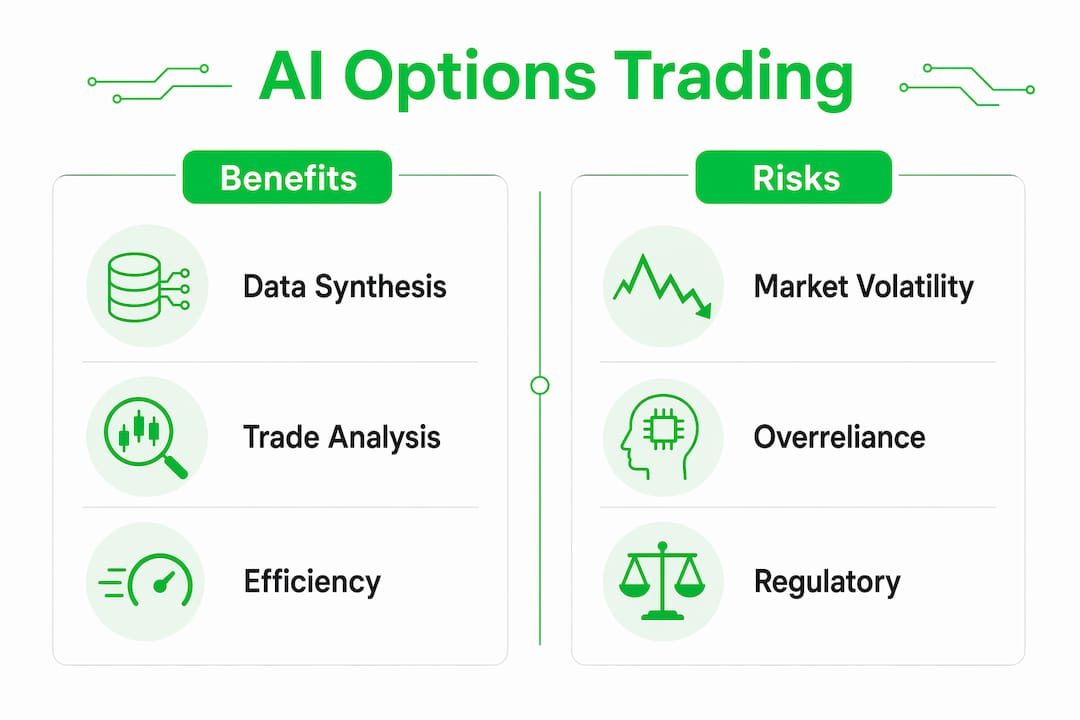
- Trade evaluation: Algorithms score potential options strategies based on volatility, pricing, and historical patterns before you commit capital.
- Data synthesis: AI condenses earnings reports, options chains, and sentiment signals into plain-language summaries.
- Social copy-trading: Platforms like Optiqtrades let you follow top-performing traders and replicate their positions directly into your own portfolio.
- Validation, not replacement: Blended human and AI advice shows stronger decision-making outcomes than either alone, according to Ontario Securities Commission research.
Regulatory awareness matters here too. General-purpose AI tools are not regulated financial advisors. Treat their output as a starting point, not a verdict.
Types of AI tools available for options traders
As of 2026, AI tools for retail traders fall into two main categories: passive automation and active research assistance.
- Robo-advisors: Automate portfolio rebalancing based on your risk tolerance. Useful for the broad equity base beneath your options activity, not for active options strategy selection.
- AI research assistants: Use machine learning for sentiment analysis, trade screening, and financial report summarization. These are the tools that help you form a thesis faster.
- AI Options Strategist: Optiqtrades’s AI Options Strategist evaluates options strategies quantitatively, integrating with your brokerage account for real-time trade monitoring and execution support.
- Social copy-trading tools: Community-driven platforms where you follow traders with verified track records and copy their trades. Optiqtrades combines this with AI evaluation on every shared trade.
- Brokerage integrations: Many AI platforms connect directly to US brokers, pulling live positions and P&L data so the AI has current context when evaluating your trades.
- Subscription and cost models: Pricing structures range from flat monthly fees to consumption-based billing. Optiqtrades offers a free tier suitable for beginners before considering paid analytics.
Risks and best practices when using AI in options investing
The single biggest risk is misplaced confidence. AI can hallucinate, producing incorrect information stated with total certainty. In options trading, where a wrong strike price or expiration date can cost you the entire premium, that is a serious problem.
- Verify everything: Cross-check AI outputs against primary sources like broker data, SEC filings, or the options chain itself.
- Avoid overreliance: Investors who follow AI advice without skepticism make worse decisions than those who treat AI as one input among several.
- Size positions for drawdowns: AI-themed positions should be sized so a 30% swing does not force you to sell. Positions should be sized conservatively to avoid forced sales during significant drawdowns.
- Ask AI to show its work: Request that it list assumptions, confidence levels, and what would invalidate its conclusion. A good AI response identifies risk triggers, not just a directional call.
- Regulatory awareness: The SEC and FINRA both monitor AI-driven trading tools. Using platforms that operate within US regulatory frameworks protects you if something goes wrong. Optiqtrades’s risk disclosure outlines exactly what the platform covers.
- Keep AI investments diversified: Spreading exposure across AI infrastructure sectors reduces the risk of a single-company blowup affecting your whole account.
Pro Tip: Ask AI for the bull case and the bear case on any trade, with the specific assumptions behind each. That forces the model to surface the conditions under which your thesis fails, which is the most useful thing it can tell you.
How to get started with AI-powered options trading
The sequence matters more than the tools you pick first.
- Step 1: Open a US brokerage account. Low-cost brokers like Fidelity, Schwab, or Tastytrade offer options trading with no per-leg commissions and support third-party integrations. Build a broad index baseline before adding any thematic or options-specific positions.
- Step 2: Learn the core options vocabulary. You need to understand calls, puts, strike price, expiration, premium, and implied volatility before AI analysis of those concepts is useful to you. AI can explain these terms, but you need to internalize them.
- Step 3: Set up Optiqtrades. Create a free account, link your brokerage, and explore the AI Options Strategist. Start by reading AI evaluations on trades other community members post before placing your own.
- Step 4: Use copy-trading with small size. Follow two or three traders with strong win rates on the leaderboard. Copy their trades at a fraction of their position size until you understand their strategy logic.
- Step 5: Set a review cadence. Check your positions weekly, not daily. Daily price-checking increases emotional trading and leads to selling at lows.
- Step 6: Watch subscription costs. Keep thematic AI tool spending proportional to your account size. Free tiers cover most beginner needs.
Pro Tip: Start with one small automated position and let it run for a full options cycle before scaling. The goal is to understand how the AI evaluation maps to real outcomes, not to maximize exposure on day one.
What an AI-assisted options trade looks like step by step
Here is a concrete example of how a beginner might use AI tools on a single trade.
A trader notices that a tech stock has earnings in two weeks. She opens the Optiqtrades market hub and sees that several followed traders have opened bull call spreads on the same ticker. The AI Options Strategist flags the trade with a quantitative evaluation: implied volatility is elevated relative to historical norms, which inflates the premium she would pay.

She prompts the AI with a structured query: “Give me the bull and bear case for this spread, list the assumptions, and tell me what would invalidate the bull thesis.” The AI returns a clear breakdown. The bear case centers on a guidance cut. She checks the most recent earnings call transcript herself to assess that risk.
She decides the position size. Because thematic bets carry higher volatility than broad-market holdings, she keeps her position size small relative to her options capital. She places the trade through her linked broker, sets a price alert at her max loss threshold, and does not check it again until the day before expiration.
The AI did not make the decision. It surfaced the data, flagged the volatility context, and forced her to think through the failure case. That is exactly the right division of labor.
Key Takeaways
AI investing works best for options traders when it handles data synthesis and trade evaluation while you retain final judgment on every position.
| Point | Details |
|---|---|
| AI as a research partner | Use AI to surface trade ideas and summarize data, not to make final decisions for you. |
| Verify before you act | AI can hallucinate; always cross-check outputs against your broker’s live options chain and primary sources. |
| Size for drawdowns | Keep thematic positions small enough that a 30% swing does not force a panic exit. |
| Blend AI with community insight | Combining AI evaluation with social copy-trading, as Optiqtrades does, produces better decision-making than either alone. |
| Optiqtrades for beginners | Optiqtrades offers free AI trade evaluations and copy-trading features built specifically for options traders starting out. |
Optiqtrades gives you AI trade evaluation and copy-trading, free
Most beginners pay for AI tools before they know what questions to ask. Optiqtrades flips that. The platform is free to join and built specifically for options traders who want AI-powered trade evaluations and a community of real traders to learn from.
Every trade shared on Optiqtrades gets an AI evaluation covering strategy logic, risk parameters, and market context. You can follow traders with verified performance records and copy their positions directly into your brokerage account at whatever size fits your risk tolerance. The AI Options Strategist connects to your broker, so the analysis reflects your actual account, not a generic model portfolio. Start free, learn from the community, and scale only when you are ready.