Best eToro Alternatives for US Investors in 2026

Best eToro Alternatives for US Investors in 2026
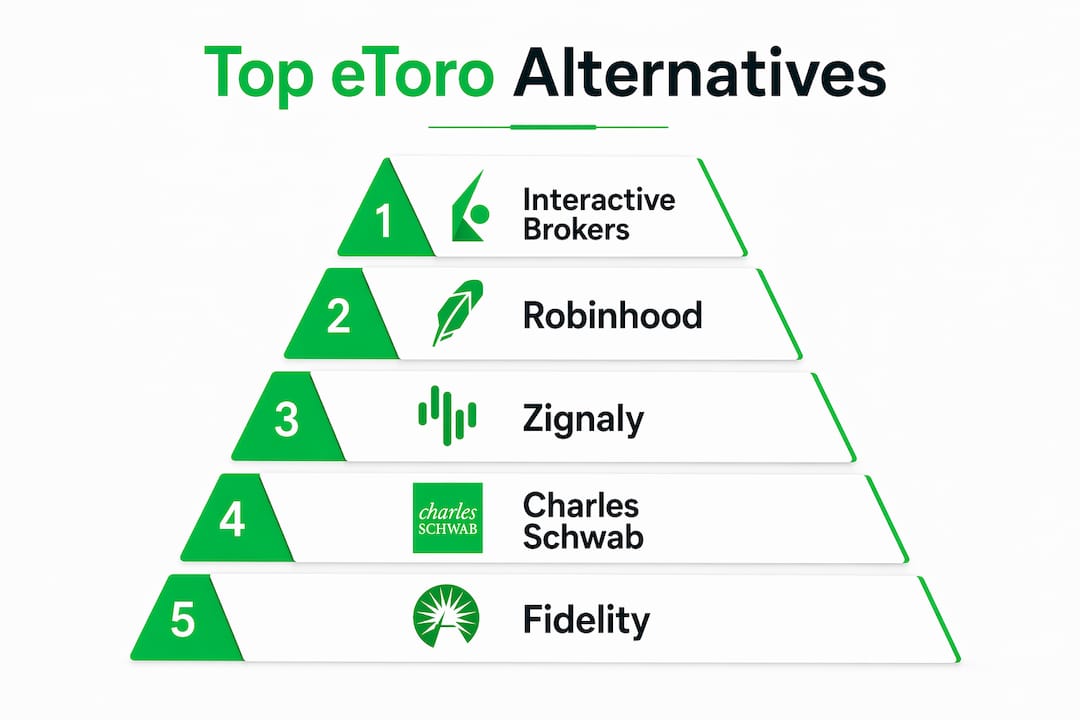
The strongest eToro alternatives for US retail investors are Interactive Brokers, Robinhood, Webull, Charles Schwab, Fidelity, Kraken, and Zignaly, each outperforming eToro on at least one dimension that matters: fees, asset depth, platform power, or social trading design. eToro’s $5 withdrawal fee, FX conversion markups up to 1.5%, and high spreads on certain products push cost-conscious traders toward alternatives with cleaner pricing. No single platform beats eToro across every category, but the right substitute depends on whether you prioritize low fees, copy trading, crypto access, or sheer market breadth.
| Platform | US Available | Asset Classes | Fee Structure | Social Trading | Regulation |
|---|---|---|---|---|---|
| Interactive Brokers | Yes | Stocks, ETFs, bonds, options, futures, forex | From $0 (Lite); 0.03% FX | No copy trading | SEC, FCA, MAS |
| Robinhood | Yes | Stocks, ETFs, options, crypto | Commission-free; spread on crypto | Social feed, verified trades | FINRA, SEC |
| Webull | Yes | Stocks, ETFs, options, crypto | Commission-free; extended hours | Community boards | FINRA, SEC |
| Kraken | Yes | Crypto (200+) | 0%–0.16% maker/taker | No | FinCEN, FCA |
| Charles Schwab | Yes | Stocks, ETFs, bonds, mutual funds, options | $0 commissions; no FX markup disclosed | No | SEC, FINRA |
| Fidelity | Yes | Stocks, ETFs, mutual funds, bonds, options | $0 commissions; no-fee funds | No | SEC, FINRA |
| SoFi | Yes | Stocks, ETFs, crypto | Commission-free | No | SEC, FINRA |
| Zignaly | Yes | Managed crypto portfolios | 10% on profits only; zero fixed fees | Automated copy portfolios | Crypto-native |
| Oanda | Yes | Forex, CFDs | Spread-based; no commissions | No | CFTC, NFA, FCA |
| Forex.com | Yes | Forex, CFDs, crypto | Spread-based; commission accounts available | No | CFTC, NFA |
| Plus500 | No (CFD) | CFDs, stocks (Invest) | Zero commissions; spread-based | No | FCA, CySEC |
| Trading 212 | No | Stocks, ETFs, CFDs, crypto | Commission-free; 0.15% FX | AutoInvest pies | FCA, CySEC |
| Saxo Bank | Yes (limited) | Stocks, ETFs, bonds, forex, options, futures, CFDs | From 0.15% (min $3–$10) | SaxoSelect portfolios | DFSA, FCA, MAS |
| DEGIRO | No | Stocks, ETFs, bonds, options, futures | €1 handling; core ETFs free | No | BaFin, AFM |
| XTB | Yes | Forex, CFDs, stocks, ETFs | Zero commission up to €100K/month | No | FCA, CySEC |
| Revolut | Yes | Stocks, ETFs, crypto | $0 (limited free trades/month) | No | ECB, FCA (limited) |
| AJ Bell | No | Stocks, ETFs, funds, bonds | Per-trade fees | No | FCA |
| Interactive Investor | No | Stocks, ETFs, funds, bonds | Flat monthly fee | No | FCA |
| Change | Limited | Crypto, banking | Varies by plan | No | EU-regulated |
| Trading.com | Yes | Stocks, ETFs, forex, crypto, CFDs | Spread-based | No | CySEC |
What makes these eToro alternatives worth considering in 2026?
The range of platforms competing with eToro has widened considerably. You now have full-service US brokers, crypto-native exchanges, fee-aligned managed platforms, and brokerage-agnostic social communities all vying for the same retail investor.
Interactive Brokers remains the benchmark for active traders who need global reach. Access to 150+ markets across 34 countries, combined with an FX conversion fee of just 0.03%, makes it the cost leader for anyone trading across currencies. The tradeoff is a notoriously steep onboarding process and a platform that rewards patience.
Robinhood took a different path. Its social feed now lets traders share verified positions and execute trades across stocks, options, futures, crypto, and prediction markets without switching apps. That integration of community and execution is genuinely new territory among US brokers.
Webull appeals to the intermediate trader who wants extended hours trading and detailed charting without paying commissions. Its community boards are less polished than Robinhood’s social layer, but the analytics depth is stronger.

Trading 212 has over 5 million customers and a 0.15% FX conversion fee, making it one of the cheapest passive investing platforms globally. It’s not available in the US, but it’s the closest structural equivalent to eToro for international investors who want commission-free stocks and ETFs with basic automation.
Zignaly operates on a model no other platform on this list uses: 10% on profits only, with zero management, deposit, or withdrawal fees. For hands-off investors who want managed crypto exposure without fixed costs, that structure removes the sting of underperformance.
Kraken is the regulated crypto exchange of choice for US traders who want depth beyond Bitcoin and Ethereum. Its maker/taker fee structure is transparent and competitive, and its security track record is strong.
Charles Schwab and Fidelity are the default answers for long-term US investors who want breadth, stability, and zero commissions without any social trading complexity. Fidelity’s no-fee mutual funds and retirement-focused tools give it a specific edge for investors building toward a 401(k) or IRA.
Saxo Bank offers 71,000+ instruments including options, forex options, and futures, making it the widest product catalog on this list. Its fees are higher than most alternatives, but for experienced traders who need that range, no other retail broker comes close.
XTB charges zero commission on trades up to €100,000 per month, which suits active retail traders who want forex and CFD access with strong educational resources. Its desktop platform has been refined over nearly 20 years.
Oanda and Forex.com both serve US forex traders specifically, with CFTC and NFA regulation, spread-based pricing, and deep charting tools. Neither offers copy trading, but both provide the regulatory clarity that forex traders in the US need.
Why do investors look for alternatives to eToro?
eToro’s drawbacks are specific and well-documented. Across 31,000+ Trustpilot reviews and Reddit threads in r/Etoro and r/ExpatFinance, three complaints appear most consistently.
- Withdrawal fees: eToro charges $5 per withdrawal, which adds up fast for active traders making frequent transfers.
- FX conversion markups: The markup runs 0.5%–1.5% depending on your account and currency. On a $10,000 investment in US stocks, that’s up to $150 in conversion costs versus $15 on Trading 212 at 0.15%.
- Spread-based pricing: eToro’s default outside the US is CFD trading, where spreads on certain assets run wider than competitors’ commission structures.
- Single currency: eToro only accepts USD for trading, creating friction for non-US investors.
- Support paywall: Real customer support requires a Club+ subscription on some tiers.
Cost reality check: A $10,000 monthly investment in US stocks costs up to $150 in FX conversion on eToro versus $15 on Trading 212 and roughly $3 on Interactive Brokers. Over 12 months, that gap compounds into a meaningful drag on returns.
The flip side is that eToro still leads on copy trading depth, social features, and geographic reach. Its CopyTrader lets you replicate the trades of over 2.5 million investors across stocks, ETFs, forex, CFDs, and crypto. No alternative on this list matches that combination of social breadth and asset variety in one place. Retail investors rarely find a single platform that beats eToro in every category, which is why the choice depends heavily on what you need most.
How to choose the right eToro alternative for your trading needs
Fee transparency is the first filter. Look beyond headline commissions to FX conversion rates, withdrawal fees, inactivity charges, and spread markups. A “commission-free” label means little if the spread on your primary asset is wide.
Asset diversity matters depending on your strategy. If you trade options, you need Robinhood, Webull, Charles Schwab, Fidelity, or Saxo Bank. If you want crypto depth, Kraken is the regulated US choice. If you want managed portfolios with zero fixed costs, Zignaly’s profit-only model is structurally unique.

Social trading features vary more than most comparisons acknowledge. The distinction between social trading and copy trading is blurring: some platforms offer community feeds where you discuss ideas, others automate full trade replication, and a few do both. Decide whether you want community engagement or fully automated mirroring before choosing.
Regulatory trust is non-negotiable for US investors. Stick to platforms regulated by the SEC, FINRA, CFTC, or NFA. Interactive Brokers, Robinhood, Webull, Charles Schwab, Fidelity, Kraken, Oanda, and Forex.com all meet that bar. Saxo Bank and XTB are FCA-regulated but have limited availability in the US.
Platform usability is subjective but consequential. Fidelity and Charles Schwab have deep research tools but steeper learning curves. Robinhood and SoFi are built for simplicity. Webull sits in between, offering advanced charting without overwhelming beginners.
Pro Tip: Before copying any trader on a social platform, check their risk-adjusted returns and maximum drawdown, not just their percentage gains. A trader showing 80% annual returns with a 60% drawdown is taking on leverage that could wipe your account in a bad month.
Detailed comparison of top eToro alternatives on fees and features
The table in the opening section covers all 20 platforms at a glance. Here’s where the meaningful differences show up in practice.
Interactive Brokers vs. eToro on fees: IBKR’s 0.03% FX conversion fee is 50 times cheaper than eToro’s worst-case 1.5%. Stock commissions on IBKR Lite are $0 for US investors. The gap is largest for active traders making frequent currency conversions.
Robinhood’s social layer: Robinhood’s verified trade-sharing feature is the closest US equivalent to eToro’s social feed. Every user and their trades are verified, which removes the anonymous bravado that plagues some trading communities. You can initiate trades directly from the social feed across stocks, options, futures, crypto, and prediction markets.
Zignaly’s fee model: Zignaly charges 10% of profits only, with no management fees, no withdrawal fees, and no deposit minimums beyond $10. If your portfolio doesn’t grow, you pay nothing. That’s structurally different from every other platform on this list, and it matters most for investors who want managed exposure without the risk of paying fees during drawdowns.
Saxo Bank’s product range: With 71,000+ instruments including forex options and futures, Saxo offers more than eToro’s roughly 7,000 instruments. Its minimum deposit varies by residency, and its Classic account carries a $1 minimum per trade. For experienced traders who need that depth, the higher fees are a reasonable tradeoff.
Fidelity and Charles Schwab for long-term investors: Both charge $0 commissions on US stocks and ETFs. Fidelity’s no-fee index funds and retirement account depth make it the stronger pick for investors building toward retirement. Schwab’s research tools and customer education resources are among the best in the industry.
XTB for forex and CFD traders: Zero commission on trades up to €100,000 per month, with low spreads and a platform refined over nearly two decades. Its educational library is one of the strongest among CFD-focused brokers, which helps newer traders understand the risks of leveraged products.
Plus500 and DEGIRO availability: Both are worth noting for international readers, but neither is available to US investors for their core CFD products. Plus500 CFD and DEGIRO are EU-focused platforms. US traders should not count on accessing them.
How social trading platforms are evolving beyond traditional brokers
The social investing model has split into two distinct types, and understanding the difference changes how you evaluate platforms.
Integrated social brokerages like eToro and Robinhood combine order execution with community features in one app. You trade and discuss in the same environment. The advantage is speed: when you see an idea you like, you can act on it immediately. The limitation is that you’re locked into that broker’s asset catalog and fee structure.
Brokerage-agnostic community apps connect to your existing accounts at multiple brokers, letting you share insights and follow other traders without moving your assets. Platforms like Iris have integrated with Fidelity, Robinhood, and Webull, offering social stock-market conversations across brokerages. The tradeoff is execution lag: you see an idea in the community app, then switch to your broker to execute it, which costs time in fast-moving markets.
- Brokerage-agnostic apps reduce asset lock-in and let you keep your existing broker relationships.
- They may induce chasing behavior, since social feeds can amplify momentum trades without the friction of switching platforms.
- Integrated platforms offer faster execution but tie your social experience to one fee structure.
- Fee models in social trading range from free community access to performance-based fees like Zignaly’s 10%-on-profits structure, to rebate models where platforms pay you per options contract traded.
The convergence point: The line between “social trading” and “copy trading” is narrowing. Robinhood’s verified trade feed lets you see and replicate positions in real time. Zignaly automates portfolio replication entirely. Experts caution that transparent leaderboards with drawdown data are the minimum standard for any platform where you’re following another trader’s decisions. Without that data, you’re copying blind.
For investors evaluating social platforms, the impact investing and ESG integration space offers a useful parallel: community-driven investing models work best when the underlying data is transparent and the incentives of the platform align with the investor’s returns, not just trading volume.
Optiqtrades offers a different approach for options traders
If you’ve compared the brokers above and found that what you actually want is a focused community of options traders sharing real strategies, not just a social feed bolted onto a stock app, Optiqtrades is worth a look.
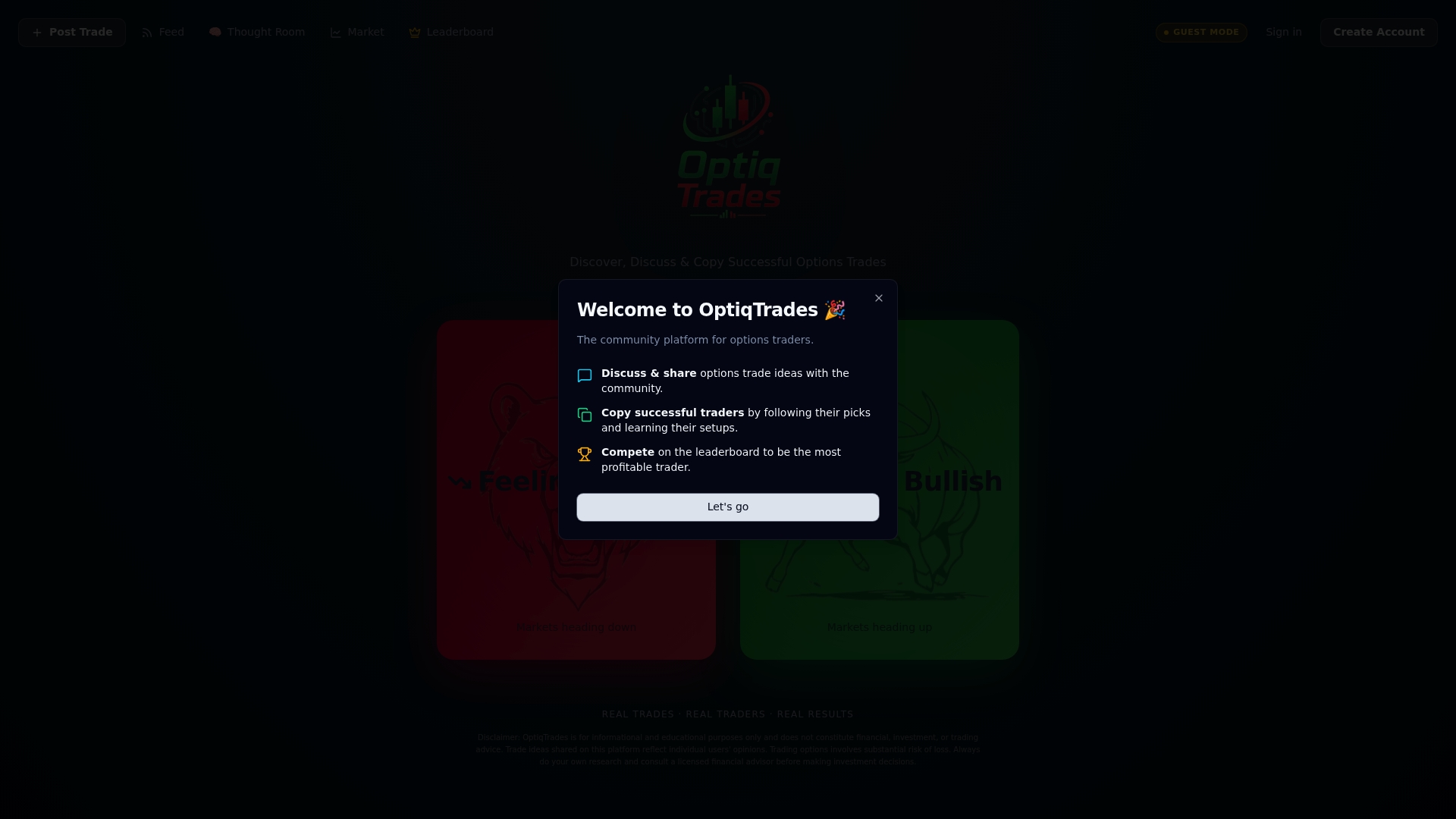
Optiqtrades is built specifically for options trading. It’s not a broker and doesn’t compete with Interactive Brokers or Fidelity on asset breadth. What it does instead is give options traders a space to share trade ideas, follow top performers, and copy trades directly into their own portfolio, with AI evaluation on every trade surfacing risk and probability data that most brokers don’t show you at the point of decision. The leaderboard is transparent: win rates, returns, and follower counts are all public, so you can assess a trader’s track record before copying a single position. It’s free to start, with a premium tier for advanced filtering. For options traders who want community depth and AI-backed analysis without paying brokerage fees for features they don’t use, that’s a meaningful alternative to the generalist platforms on this list.
Key Takeaways
Interactive Brokers, Robinhood, and Zignaly lead as eToro alternatives for US investors in 2026, each excelling on a distinct dimension: fees, social trading, and fee-aligned automation respectively.
| Point | Details |
|---|---|
| Fee gap is real | eToro’s FX conversion markup runs up to 1.5%; Interactive Brokers charges 0.03% and Trading 212 charges 0.15%. |
| Social trading is splitting | Integrated brokers like Robinhood combine execution and community; brokerage-agnostic apps like Iris connect across multiple brokers without asset migration. |
| Zignaly’s fee model stands alone | Zignaly charges 10% on profits only, with zero fixed fees, making it the only platform where you pay nothing during drawdowns. |
| US availability limits choices | Plus500 CFD and DEGIRO are not available to US investors; always verify regulatory access before opening an account. |
| Optiqtrades for options focus | Optiqtrades offers AI trade evaluation, transparent leaderboards, and copy trading built specifically for options traders, free to start. |